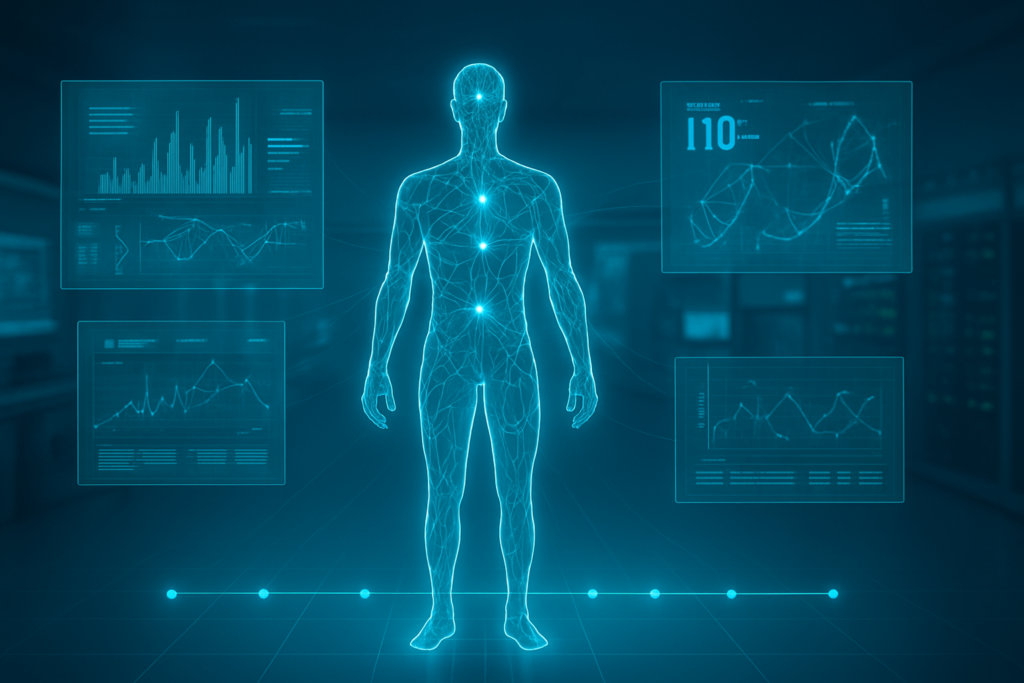
In a development that many are hailing as the "AlphaFold moment" for clinical medicine, an international research consortium has unveiled Delphi-2M, a generative transformer model capable of forecasting the progression of more than 1,200 diseases up to 20 years in advance. By treating a patient’s medical history as a linguistic sequence—where health events are "words" and a person's life is the "sentence"—the model has demonstrated an uncanny ability to predict not just what diseases a person might develop, but exactly when they are likely to occur.
The announcement, which first broke in late 2025 through a landmark study in Nature, marks a definitive shift from reactive healthcare to a new era of proactive, "longitudinal" medicine. Unlike previous AI tools that focused on narrow tasks like detecting a tumor on an X-ray, Delphi-2M provides a comprehensive "weather forecast" for human health, analyzing the complex interplay between past diagnoses, lifestyle choices, and demographic factors to simulate thousands of potential future health trajectories.
The "Grammar" of Disease: How Delphi-2M Decodes Human Health
Technically, Delphi-2M is a modified Generative Pre-trained Transformer (GPT) based on the nanoGPT architecture. Despite its relatively modest size of 2.2 million parameters, the model punches far above its weight class due to the high density of its training data. Developed by a collaboration between the European Molecular Biology Laboratory (EMBL), the German Cancer Research Center (DKFZ), and the University of Copenhagen, the model was trained on the UK Biobank dataset of 400,000 participants and validated against 1.9 million records from the Danish National Patient Registry.
What sets Delphi-2M apart from existing medical AI like Alphabet Inc.'s (NASDAQ: GOOGL) Med-PaLM 2 is its fundamental objective. While Med-PaLM 2 is designed to answer medical questions and summarize notes, Delphi-2M is a "probabilistic simulator." It utilizes a unique "dual-head" output: one head predicts the type of the next medical event (using a vocabulary of 1,270 disease and lifestyle tokens), while the second head predicts the time interval until that event occurs. This allows the model to achieve an average area under the curve (AUC) of 0.76 across 1,258 conditions, and a staggering 0.97 for predicting mortality.
The research community has reacted with a mix of awe and strategic recalibration. Experts note that Delphi-2M effectively consolidates hundreds of specialized clinical calculators—such as the QRISK score for cardiovascular disease—into a single, cohesive framework. By integrating Body Mass Index (BMI), smoking status, and alcohol consumption alongside chronological medical codes, the model captures the "natural history" of disease in a way that static diagnostic tools cannot.
A New Battlefield for Big Tech: From Chatbots to Predictive Agents
The emergence of Delphi-2M has sent ripples through the tech sector, forcing a pivot among the industry's largest players. Oracle Corporation (NYSE: ORCL) has emerged as a primary beneficiary of this shift. Following its aggressive acquisition of Cerner, Oracle has spent late 2025 rolling out a "next-generation AI-powered Electronic Health Record (EHR)" built natively on Oracle Cloud Infrastructure (OCI). For Oracle, models like Delphi-2M are the "intelligence engine" that transforms the EHR from a passive filing cabinet into an active clinical assistant that alerts doctors to a patient’s 10-year risk of chronic kidney disease or heart failure during a routine check-up.
Meanwhile, Microsoft Corporation (NASDAQ: MSFT) is positioning its Azure Health platform as the primary distribution hub for these predictive models. Through its "Healthcare AI Marketplace" and partnerships with firms like Health Catalyst, Microsoft is enabling hospitals to deploy "Agentic AI" that can manage population health at scale. On the hardware side, NVIDIA Corporation (NASDAQ: NVDA) continues to provide the essential "AI Factory" infrastructure. NVIDIA’s late-2025 partnerships with pharmaceutical giants like Eli Lilly and Company (NYSE: LLY) highlight how predictive modeling is being used not just for patient care, but to identify cohorts for clinical trials years before they become symptomatic.
For Alphabet Inc. (NASDAQ: GOOGL), the rise of specialized longitudinal models presents a competitive challenge. While Google’s Gemini 3 remains a leader in general medical reasoning, the company is now under pressure to integrate similar "time-series" predictive capabilities into its health stack to prevent specialized models like Delphi-2M from dominating the clinical decision-support market.
Ethical Frontiers and the "Immortality Bias"
Beyond the technical and corporate implications, Delphi-2M raises profound questions about the future of the AI landscape. It represents a transition from "generative assistance" to "predictive autonomy." However, this power comes with significant caveats. One of the most discussed issues in the late 2025 research is "immortality bias"—a phenomenon where the model, trained on the specific age distributions of the UK Biobank, initially struggled to predict mortality for individuals under 40.
There are also deep concerns regarding data equity. The "healthy volunteer bias" inherent in the UK Biobank means the model may be less accurate for underserved populations or those with different lifestyle profiles than the original training cohort. Furthermore, the ability to predict a terminal illness 20 years in advance creates a minefield for the insurance industry and patient privacy. If a model can predict a "health trajectory" with high accuracy, how do we prevent that data from being used to deny coverage or employment?
Despite these concerns, the broader significance of Delphi-2M is undeniable. It provides a "proof of concept" that the same transformer architectures that mastered human language can master the "language of biology." Much like AlphaFold revolutionized protein folding, Delphi-2M is being viewed as the foundation for a "digital twin" of human health.
The Road Ahead: Synthetic Patients and Preventative Policy
In the near term, the most immediate application for Delphi-2M may not be in the doctor’s office, but in the research lab. The model’s ability to generate synthetic patient trajectories is a game-changer for medical research. Scientists can now create "digital cohorts" of millions of simulated patients to test the potential long-term impact of new drugs or public health policies without the privacy risks or costs associated with real-world longitudinal studies.
Looking toward 2026 and beyond, experts predict the integration of genomic data into the Delphi framework. By combining the "natural history" of a patient’s medical records with their genetic blueprint, the predictive window could extend even further, potentially identifying risks from birth. The challenge for the coming months will be "clinical grounding"—moving these models out of the research environment and into validated medical workflows where they can be used safely by clinicians.
Conclusion: The Dawn of the Predictive Era
The release of Delphi-2M in late 2025 stands as a watershed moment in the history of artificial intelligence. It marks the point where AI moved beyond merely understanding medical data to actively simulating the future of human health. By achieving high-accuracy predictions across 1,200 diseases, it has provided a roadmap for a healthcare system that prevents illness rather than just treating it.
As we move into 2026, the industry will be watching closely to see how regulatory bodies like the FDA and EMA respond to "predictive agent" technology. The long-term impact of Delphi-2M will likely be measured not just in the stock prices of companies like Oracle and NVIDIA, but in the years of healthy life added to the global population through the power of foresight.
This content is intended for informational purposes only and represents analysis of current AI developments.
TokenRing AI delivers enterprise-grade solutions for multi-agent AI workflow orchestration, AI-powered development tools, and seamless remote collaboration platforms.
For more information, visit https://www.tokenring.ai/.