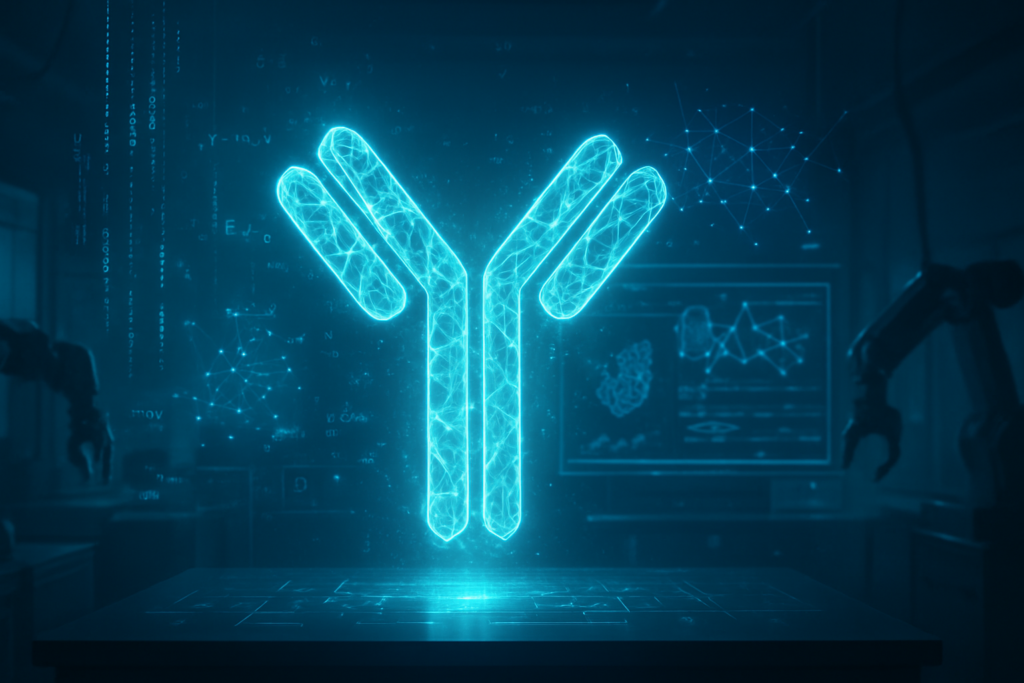
In a milestone that many scientists once considered a "pipe dream" for the next decade, researchers at the University of Washington’s (UW) Institute for Protein Design (IPD) announced in late 2025 the first successful de novo design of functional antibodies using generative artificial intelligence. The breakthrough, published in Nature on November 5, 2025, marks the transition from discovering medicines by chance to engineering them by design. By using AI to "dream up" molecular structures that do not exist in nature, the team has effectively bypassed decades of traditional, animal-based laboratory work, potentially shortening the timeline for new drug development from years to mere weeks.
This development is not merely a technical curiosity; it is a fundamental shift in the $200 billion antibody drug industry. For the first time, scientists have demonstrated that a generative model can create "atomically accurate" antibodies—the immune system's primary defense—tailored to bind to specific, high-value targets like the influenza virus or cancer-causing proteins. As the world moves into 2026, the implications for pandemic preparedness and the treatment of chronic diseases are profound, signaling a future where the next global health crisis could be met with a designer cure within days of a pathogen's identification.
The Rise of RFantibody: From "Dreaming" to Atomic Reality
The technical foundation of this breakthrough lies in a specialized suite of generative AI models, most notably RFdiffusion and its antibody-specific iteration, RFantibody. Developed by the lab of Nobel Laureate David Baker, these models operate similarly to generative image tools like DALL-E, but instead of pixels, they manipulate the 3D coordinates of atoms. While previous AI attempts could only modify existing antibodies found in nature, RFantibody allows researchers to design the crucial "complementarity-determining regions" (CDRs)—the finger-like loops that grab onto a pathogen—entirely from scratch.
To ensure these "hallucinated" proteins would function in the real world, the UW team employed a rigorous computational pipeline. Once RFdiffusion generated a 3D shape, ProteinMPNN determined the exact sequence of amino acids required to maintain that structure. The designs were then "vetted" by AlphaFold3, developed by Google DeepMind—a subsidiary of Alphabet Inc. (NASDAQ: GOOGL)—and RoseTTAFold2 to predict their binding success. In a stunning display of precision, cryo-electron microscopy confirmed that four out of five of the top AI-designed antibodies matched their computer-predicted structures with a deviation of less than 1.5 angstroms, roughly the width of a single atom.
This approach differs radically from the traditional "screening" method. Historically, pharmaceutical companies would inject a target protein into an animal (like a mouse or llama) and wait for its immune system to produce antibodies, which were then harvested and refined. This "black box" process was slow, expensive, and often failed to target the most effective sites on a virus. The UW breakthrough replaces this trial-and-error approach with "rational design," allowing scientists to target the "Achilles' heel" of a virus—such as the highly conserved stem of the influenza virus—with mathematical certainty.
The reaction from the scientific community has been one of collective awe. Dr. David Baker described the achievement as a "grand challenge" finally met, while lead authors of the study noted that this represents a "landmark moment" that will define how antibodies are designed for the next decade. Industry experts have noted that the success rate of these AI-designed molecules, while still being refined, already rivals or exceeds the efficiency of traditional discovery platforms when accounting for the speed of iteration.
A Seismic Shift in the Pharmaceutical Landscape
The commercial impact of the UW breakthrough was felt immediately across the biotechnology sector. Xaira Therapeutics, a startup co-founded by David Baker that launched with a staggering $1 billion in funding from ARCH Venture Partners, has already moved to exclusively license the RFantibody technology. Xaira’s emergence as an "end-to-end" AI biotech poses a direct challenge to traditional Contract Research Organizations (CROs) that rely on massive animal-rearing infrastructures. By moving the discovery process to the cloud, Xaira aims to outpace legacy competitors in both speed and cost-efficiency.
Major pharmaceutical giants are also racing to integrate these generative capabilities. Eli Lilly and Company (NYSE: LLY) recently announced a shift toward "AI-powered factories" to automate the design-to-production cycle, while Pfizer Inc. (NYSE: PFE) has leveraged similar de novo design techniques to hit preclinical milestones 40% faster than previous years. Amgen Inc. (NASDAQ: AMGN) has reinforced its "Biologics First" strategy by using generative design to tackle "undruggable" targets—complex proteins that have historically resisted traditional antibody binding.
Meanwhile, Regeneron Pharmaceuticals, Inc. (NASDAQ: REGN), which built its empire on the "VelociSuite" humanized mouse platform, is increasingly integrating AI to guide the design of multi-specific antibodies. The competitive advantage is no longer about who has the largest library of natural molecules, but who has the most sophisticated generative models and the highest-quality data to train them. This democratization of drug discovery means that smaller biotech firms can now design complex biologics that were previously the exclusive domain of "Big Pharma," potentially leading to a surge in specialized treatments for rare diseases.
Global Security and the "100 Days Mission"
Beyond the balance sheets of Wall Street, the UW breakthrough carries immense weight for global health security. The Coalition for Epidemic Preparedness Innovations (CEPI) has identified AI-driven de novo design as a cornerstone of its "100 Days Mission"—an ambitious global goal to develop vaccines or therapeutics within 100 days of a new viral outbreak. In late 2025, CEPI integrated the IPD’s generative models into its "Pandemic Preparedness Engine," a system designed to computationally "pre-solve" antibodies for viral families like coronaviruses and avian flu (H5N1) before they even cross the species barrier.
This milestone is being compared to the "AlphaFold moment" of 2020, but with a more direct path to clinical application. While AlphaFold solved the problem of how proteins fold, RFantibody solves the problem of how proteins interact and function. This is the difference between having a map of a city and being able to build a key that unlocks any door in that city. The ability to design "universal" antibodies—those that can neutralize multiple strains of a rapidly mutating virus—could end the annual "guessing game" associated with seasonal flu vaccines and provide a permanent shield against future pandemics.
However, the breakthrough also raises ethical and safety concerns. The same technology that can design a life-saving antibody could, in theory, be used to design novel toxins or enhance the virulence of pathogens. This has prompted calls for "biosecurity guardrails" within generative AI models. Leading researchers, including Baker, have been proactive in advocating for international standards that screen AI-generated protein sequences against known biothreat databases, ensuring that the democratization of biology does not come at the cost of global safety.
The Road to the Clinic: What’s Next for AI Biologics?
The immediate focus for the UW team and their commercial partners is moving these AI-designed antibodies into human clinical trials. While the computational results are flawless, the complexity of the human immune system remains the ultimate test. In the near term, we can expect to see the first "AI-only" antibody candidates for Influenza and C. difficile enter Phase I trials by mid-2026. These trials will be scrutinized for "developability"—ensuring that the synthetic molecules are stable, non-toxic, and can be manufactured at scale.
Looking further ahead, the next frontier is the design of "multispecific" antibodies—single molecules that can bind to two or three different targets simultaneously. This is particularly promising for cancer immunotherapy, where an antibody could be designed to grab a cancer cell with one "arm" and an immune T-cell with the other, forcing an immune response. Experts predict that by 2030, the majority of new biologics entering the market will have been designed, or at least heavily optimized, by generative AI.
The challenge remains in the "wet lab" validation. While AI can design a molecule in seconds, testing it in a physical environment still takes time. The integration of "self-driving labs"—robotic systems that can synthesize and test AI designs without human intervention—will be the next major hurdle to overcome. As these robotic platforms catch up to the speed of generative AI, the cycle of drug discovery will accelerate even further, potentially bringing us into an era of personalized, "on-demand" medicine.
A New Era for Molecular Engineering
The University of Washington’s achievement in late 2025 will likely be remembered as the moment the biological sciences became a true engineering discipline. By proving that AI can design functional, complex proteins with atomic precision, the IPD has opened a door that can never be closed. The transition from discovery to design is not just a technological upgrade; it is a fundamental change in our relationship with the molecular world.
The key takeaway for the industry is clear: the "digital twin" of biology is now accurate enough to drive real-world clinical outcomes. In the coming weeks and months, all eyes will be on the regulatory response from the FDA and other global bodies as they grapple with how to approve medicines designed by an algorithm. If the clinical trials prove successful, the legacy of this 2025 breakthrough will be a world where disease is no longer an insurmountable mystery, but a series of engineering problems waiting for an AI-generated solution.
This content is intended for informational purposes only and represents analysis of current AI developments.
TokenRing AI delivers enterprise-grade solutions for multi-agent AI workflow orchestration, AI-powered development tools, and seamless remote collaboration platforms.
For more information, visit https://www.tokenring.ai/.