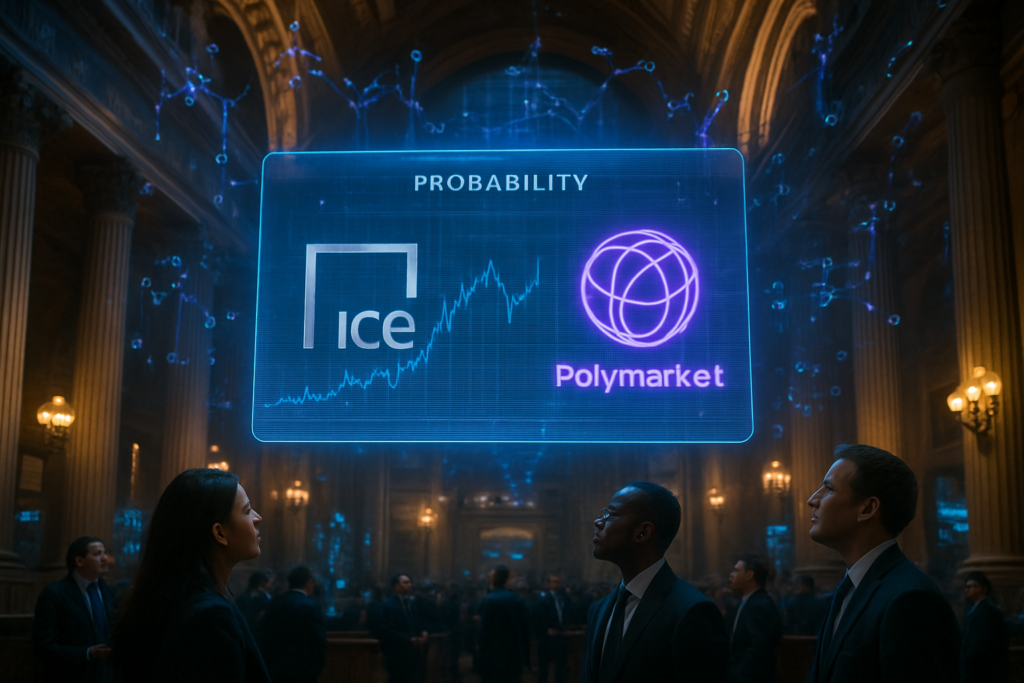
On January 15, 2026, the global financial landscape has been permanently altered by a collision between the old world of institutional finance and the new frontier of decentralized intelligence. The Intercontinental Exchange (NYSE: ICE), the powerhouse parent company of the New York Stock Exchange, has finalized a landmark $2 billion investment into Polymarket, the world’s leading decentralized prediction platform. This capital injection, first announced in late 2025, has acted as a catalyst for a valuation surge that now sees Polymarket in ongoing funding talks at a staggering $12 billion to $15 billion range—a ten-fold increase from its status just six months ago.
This move marks a definitive turning point in how global markets price reality. With daily trading volumes on the platform peaking at over $700 million this month, traders are no longer just betting on outcomes; they are creating a new, liquid asset class out of human expectations. The convergence of ICE’s legacy infrastructure with Polymarket’s blockchain-based forecasting suggests that "truth" is becoming the most valuable commodity on the NYSE's books.
The Market: What's Being Predicted
While the primary "market" generating headlines today is the valuation of the platform itself, the underlying activity on Polymarket has reached unprecedented levels. As of mid-January 2026, the platform is dominated by high-stakes macroeconomic and entertainment contracts that function as real-time sentiment indicators for Wall Street. The "Fed Decision in January 2026" market has already cleared $360 million in volume, with traders currently pricing in a 95% probability that the Federal Reserve will hold interest rates steady on January 28.
Trading liquidity has also reached a fever pitch in the entertainment sector. Ahead of the 98th Academy Awards, the market for Best Picture has attracted over $100 million in bets, with Paul Thomas Anderson’s One Battle After Another currently favored at 82%. Unlike traditional polling, which relies on static data, these markets are trading 24/7, providing a live ticker for shifting public perception that legacy media outlets are now forced to cite in their daily coverage. The resolution of these markets is handled via decentralized oracles, ensuring that payouts are automated and immune to the intervention of any central authority—a feature that was once a hurdle for institutional adoption but is now being embraced as a transparency gold standard.
Why Traders Are Betting
The surge in betting activity is driven by a fundamental shift in how both retail and institutional players view prediction markets. Following the massive success of the 2024 U.S. election cycle—which saw Polymarket process nearly $19 billion in cumulative volume—the platform has proven its accuracy often outweighs traditional forecasting models. Institutional "whales" are now using these markets as sophisticated hedging tools. For instance, a hedge fund holding significant tech positions might bet on a 75% probability of an AI-related regulatory bill passing to offset potential stock losses.
Recent news has also played a critical role. The integration of Polymarket's data feeds directly into ICE’s distribution network has allowed institutional clients to view prediction odds alongside traditional market data. This "institutional seal of approval" has brought a wave of professional liquidity. Traders are also reacting to the platform’s newfound regulatory stability. By acquiring the CFTC-licensed exchange QCEX in late 2025, Polymarket effectively ended its years-long "regulatory exile," allowing American traders to legally participate in the ecosystem alongside international peers, vastly increasing the depth of every order book.
Broader Context and Implications
The $2 billion investment by Intercontinental Exchange (NYSE: ICE) is more than a simple capital raise; it is a strategic takeover of the data distribution layer for the next generation of finance. ICE has become the global distributor for Polymarket's event-driven data, effectively treating prediction probabilities as a "financial primitive" similar to stock prices or interest rate benchmarks. This trend is being mirrored across the industry, with competitors like CME Group (NASDAQ: CME) and Robinhood (NASDAQ: HOOD) racing to integrate their own prediction market hubs to capture the explosive growth in event-based trading.
However, the rise of a $15 billion prediction giant has not come without friction. The "Public Integrity in Financial Prediction Markets Act of 2026," currently being debated in Congress, seeks to address concerns over insider trading. The bill was prompted by a controversial "Maduro trade" earlier this month, where a user reportedly made $400,000 on a market regarding U.S. military movements hours before the official announcement. This highlight’s the platform’s dual nature: while it is an incredibly accurate "truth engine," it also provides a lucrative incentive for those with non-public information to move the markets.
What to Watch Next
The most immediate milestone for the sector is the outcome of the "ORACLE Act" in New York. State lawmakers are currently debating a bill that would ban New York residents from trading on political or sports-related contracts. If passed, it would set up a high-stakes legal showdown between state regulators and the federal CFTC, which has largely moved toward a pro-innovation stance under recent leadership. A victory for Polymarket in New York would likely clear the final hurdle for a much-anticipated Initial Public Offering (IPO) later in 2026.
Additionally, the upcoming Super Bowl LXI in February is expected to be the largest sports-betting event in history for prediction markets. With Kalshi and Polymarket now competing head-to-head for the U.S. sports audience, the total volume for a single game could exceed $2 billion. Traders should watch for any new partnerships between these platforms and major sports leagues, which would further cement the transition from "illegal gambling" to "regulated event-based derivatives."
Bottom Line
The partnership between ICE and Polymarket represents the definitive end of the "experiment phase" for decentralized prediction markets. When the owner of the NYSE decides that a blockchain-based betting platform is worth a multibillion-dollar investment, it signals that the world’s most powerful financial institutions no longer trust traditional polls or pundits—they trust the market.
As we move deeper into 2026, prediction markets are evolving from a niche interest into a foundational piece of the global financial stack. Whether you are a hedge fund manager looking to hedge political risk or a retail trader betting on the Oscars, the message is clear: the most accurate way to see the future is to look at where the money is moving. While regulatory and legislative hurdles remain, the $15 billion valuation of Polymarket suggests that the "prediction economy" is here to stay, and its influence on public policy and financial markets will only grow from here.
This article is for informational purposes only and does not constitute financial or betting advice. Prediction market participation may be subject to legal restrictions in your jurisdiction.
PredictStreet focuses on covering the latest developments in prediction markets.
Visit the PredictStreet website at https://www.predictstreet.ai/.