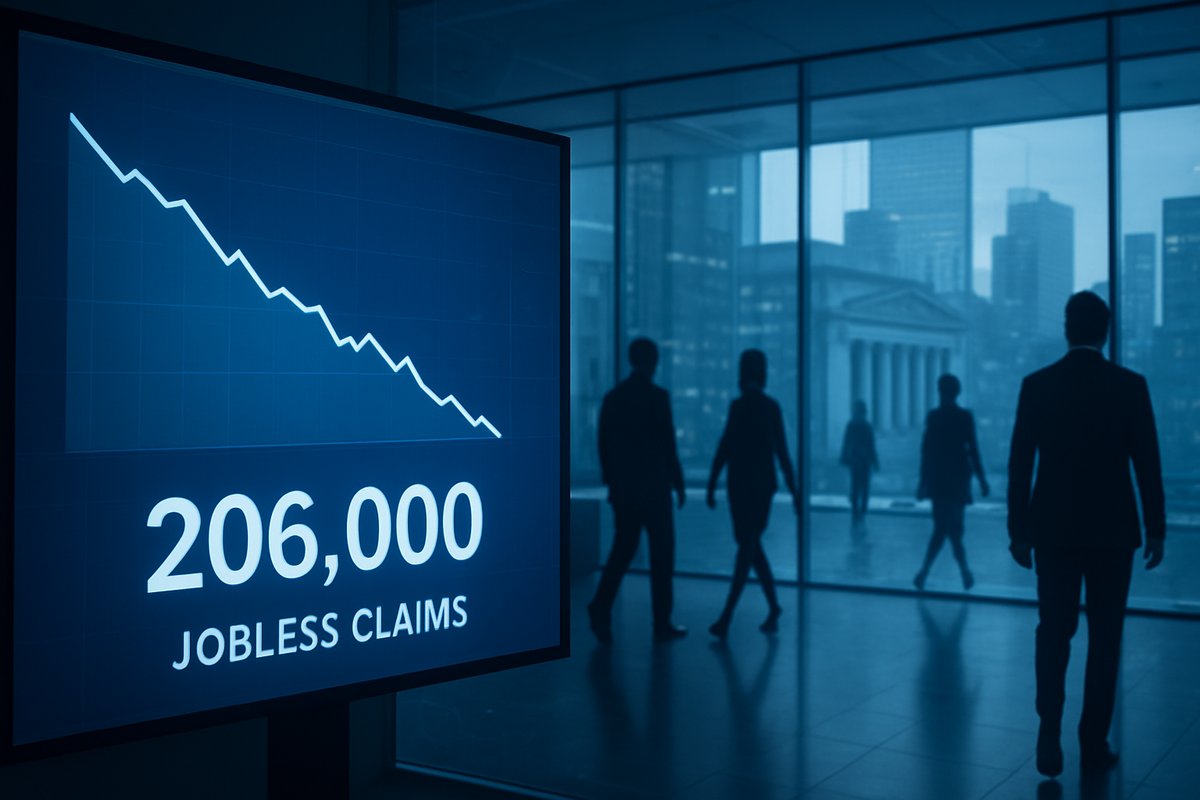
The U.S. labor market continues to exhibit a startling resilience that is complicating the Federal Reserve’s path toward monetary easing. New data released on February 19, 2026, revealed that initial jobless claims for the week ending February 14 dropped to 206,000, a sharp decline of 23,000 from the previous week. This figure significantly beat Wall Street expectations of 225,000, signaling that despite a cooling economy and widespread corporate restructuring in the tech sector, the "mass layoff" event many bears predicted has failed to materialize.
The immediate implication of this data is a dramatic shift in market sentiment regarding interest rates. For months, investors had been pricing in a series of aggressive rate cuts starting in early 2026 to combat a perceived slowdown. However, the unexpected strength in the employment sector provides the Federal Reserve with the "breathing room" to maintain its current "higher-for-longer" stance. As the 10-year Treasury yield ticked upward following the report, the message from the labor market was clear: the economy may be bending under the weight of high rates, but it is far from breaking.
A "Low-Hire, Low-Fire" Equilibrium Takes Hold
The drop to 206,000 claims marks one of the lowest levels of new unemployment filings since the "stagnation period" of mid-2025. This resurgence of labor stability comes on the heels of a volatile winter characterized by federal government shutdown threats and severe weather disruptions that briefly spiked claims above 230,000. Economists are now describing the current state of the workforce as a "low-hire, low-fire" equilibrium. While the feverish hiring sprees of the post-pandemic era have long since cooled, employers appear to be "labor hoarding"—clinging to skilled talent they struggled to acquire in previous years, even as they pause new headcount growth.
The timeline leading to this moment has been a source of intense debate among policymakers. Throughout late 2025, the U.S. Bureau of Labor Statistics (BLS) issued significant benchmark revisions, revealing that job growth in the previous year was the weakest since 2003, excluding recessionary periods. This led to a brief period of panic where markets demanded immediate Fed intervention. However, as 2026 began, the data began to stabilize. The January employment report showed a surprising addition of 130,000 jobs, and the national unemployment rate dipped from 4.4% to 4.3%. The latest 206,000 claims figure serves as a definitive confirmation that the labor market is entering a phase of structural balance rather than a downward spiral.
Initial market reactions were swift and "hawkish." Major indices saw a modest sell-off as traders recalculated the odds of a March rate cut, shifting their focus instead to the June and September FOMC meetings. The Federal Reserve, under the outgoing leadership of Jerome Powell and the incoming influence of nominee Kevin Warsh, has remained steadfast in its commitment to a 2.0% inflation target. With core PCE (Personal Consumption Expenditures) remaining sticky between 2.5% and 2.8%, the Fed views the low jobless claims as a signal that the economy does not yet require the life support of lower borrowing costs.
Corporate Winners and Losers in a Persistent Rate Environment
The "higher-for-longer" reality created by a strong labor market is producing a distinct set of winners and losers across the S&P 500. Financial institutions, most notably JPMorgan Chase (NYSE: JPM) and Goldman Sachs (NYSE: GS), are emerging as primary beneficiaries. For these banking giants, delayed rate cuts translate to sustained Net Interest Margins (NIM), allowing them to remain highly profitable even as the volume of IPOs and M&A activity remains subdued. JPMorgan has already leaned into this "hawkish" consensus, forecasting that the labor market’s tightness will support a positive outlook for banking revenues through the first half of 2026.
Conversely, the technology sector faces a more complex set of challenges. Amazon (NASDAQ: AMZN) recently announced a restructuring plan involving 16,000 layoffs, as it seeks to "reduce bureaucracy" and reallocate capital toward a massive $200 billion AI and satellite infrastructure plan. For high-growth tech firms like Amazon and Alphabet (NASDAQ: GOOGL), persistent high rates increase the cost of the massive debt required to fund the AI arms race. Alphabet’s recent issuance of a rare 100-year bond highlights the extreme measures companies are taking to secure long-term capital in a restrictive environment. While these companies are cutting human headcount to improve "AI efficiency," the overall low jobless claims suggest that these workers are being absorbed by other sectors, preventing a systemic collapse in consumer spending.
Meanwhile, the semiconductor industry remains insulated from the broader labor malaise. Nvidia (NASDAQ: NVDA), which reached a staggering $4.6 trillion market cap in February 2026, continues to be viewed as a "recession-proof" play. As long as the labor market remains strong enough to keep the economy afloat, the demand for Nvidia’s AI infrastructure remains insatiable. On the retail side, Walmart (NYSE: WMT) reported strong quarterly results but warned that "persistent core inflation" and high interest rates are beginning to weigh on lower-income consumer confidence. For Walmart, a strong labor market is a double-edged sword: it keeps customers employed and spending, but it also keeps wage pressure high and prevents the Fed from lowering the credit costs that drive big-ticket purchases.
Structural Shifts and Historical Precedents
The current labor resilience fits into a broader industry trend of "Agentic AI" adoption, where companies are increasingly using autonomous AI agents to handle administrative and middle-management tasks. This allows the economy to maintain high output with fewer new hires, explaining why jobless claims remain low even as payroll growth remains modest compared to historical norms. We are witnessing a decoupling of "labor demand" and "headcount growth"; companies need talent, but they are becoming increasingly surgical about where that talent is applied.
Historically, the 206,000 claims level invites comparisons to the late 1990s, another period where technological advancement (the internet) allowed for productivity gains that kept the labor market tight despite high interest rates. The ripple effect of this "K-shaped" resilience is that it protects the U.S. from a "hard landing" but creates a policy trap for the Federal Reserve. If the Fed cuts rates too early to help the struggling manufacturing or retail sectors, it risks re-igniting inflation fueled by the still-employed and high-earning service sector workforce.
From a regulatory standpoint, the strength of the labor market may embolden the Department of Labor and other agencies to maintain strict oversight on worker protections and minimum wage standards, as the "emergency" of high unemployment has not materialized. However, the 1.87 million continuing claims—those already unemployed who are struggling to find new roles—suggest a growing "skills gap" that may require federal policy intervention in the form of AI-retraining programs later in the decade.
The Path to June: What Comes Next?
In the short term, all eyes will turn to the upcoming March FOMC meeting. While a rate hike is virtually off the table, the "Dot Plot" and the Fed's commentary will be scrutinized for any sign of a pivot. If jobless claims remain near the 200,000 mark through the spring, it is highly likely that the first rate cut will be pushed back to at least June 2026. Companies will need to adapt by continuing their focus on "operational efficiency" and internal capital allocation rather than relying on cheap debt for expansion.
The potential for a "strategic pivot" is highest in the tech and real estate sectors. Real estate developers, who have been sidelined by high borrowing costs, may have to accept that the "new normal" for interest rates is significantly higher than the zero-bound era of the 2010s. For investors, the opportunity lies in sectors that can thrive in a stable, high-rate environment—specifically insurance, energy, and high-margin software-as-a-service (SaaS) providers that do not require constant capital infusions.
Summary and Market Outlook
The drop in weekly initial jobless claims to 206,000 is a testament to the underlying durability of the U.S. economy, but it serves as a "hawkish" warning for those hoping for a quick return to low interest rates. The labor market has effectively neutralized the "recession" narrative for the first half of 2026, forcing a re-evaluation of valuation models across all asset classes.
As we move forward, investors should watch for two key indicators: the "Continuing Claims" data and the Core PCE inflation reports. If continuing claims continue to rise while initial claims stay low, it will signal a deepening structural mismatch in the workforce that could eventually weigh on GDP. For now, the "low-hire, low-fire" environment remains the dominant theme. The Federal Reserve has been granted the gift of time, and how they use it—either to finally crush inflation or to wait until the "AI transition" causes more significant labor friction—will define the market's trajectory for the rest of 2026.
This content is intended for informational purposes only and is not financial advice.