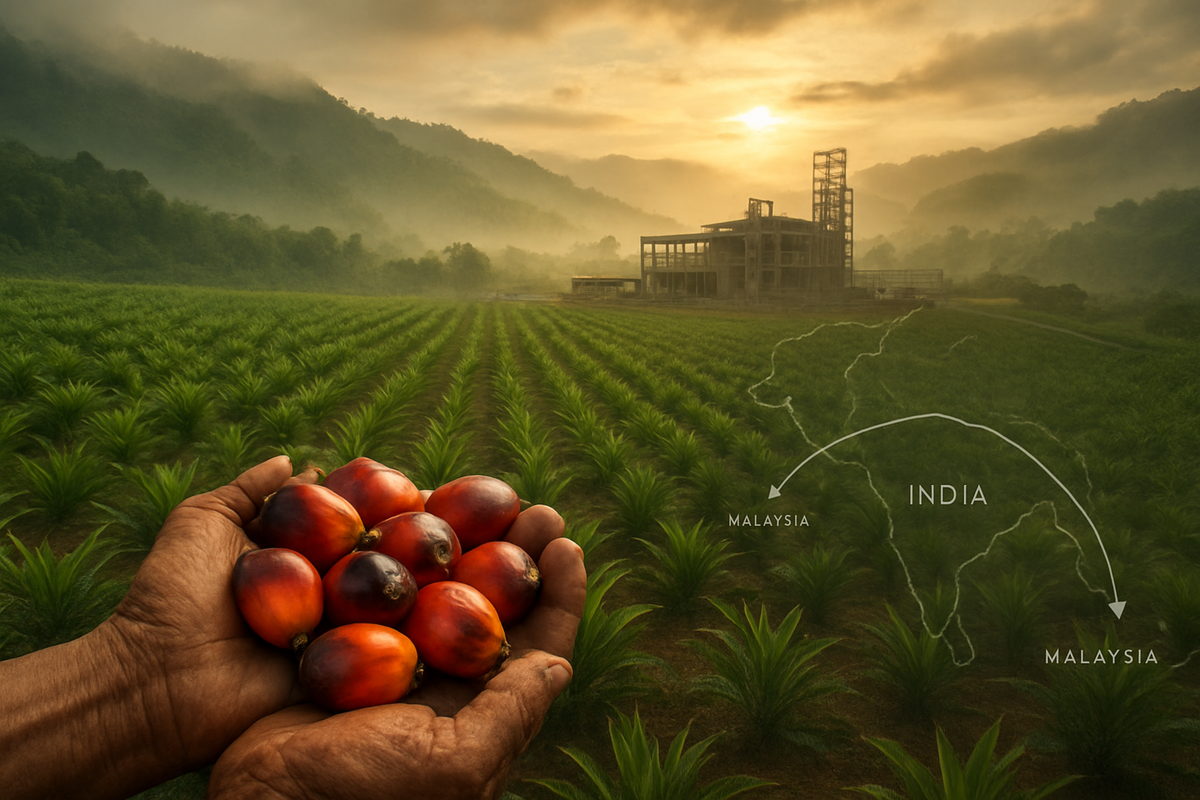
As of February 20, 2026, the global edible oil market is witnessing a tectonic shift in trade dynamics, catalyzed by India’s aggressive pursuit of "Atmanirbhar" or self-reliance in oilseeds. At the heart of this transformation is a strategic five-year partnership between Patanjali Foods Limited (NSE: PATANJALI) and Malaysian state-run suppliers. The deal, which has recently reached a critical milestone with the delivery and planting of 1.5 million high-yield oil palm seeds, marks a transition from simple commodity importing to deep-rooted vertical integration. This move is not merely a corporate procurement strategy; it is a calculated effort to insulate the world's largest edible oil importer from the volatile swings of Southeast Asian export policies and global shipping disruptions.
The immediate implications of this deal are already reflecting in the domestic agricultural landscape. By securing 1.5 million seeds—part of a larger 4-million seed framework—Patanjali is effectively locking in its supply chain for the next decade. These seeds are currently being deployed across the fertile terrains of Northeast India and parts of the South, under the umbrella of the National Mission on Edible Oils – Oil Palm (NMEO-OP). For the market, this represents a long-term hedge against the rising "Green Protectionism" seen in Indonesia and Malaysia, where domestic biodiesel mandates are increasingly swallowing up exportable surpluses of crude palm oil.
The Architecture of Integration: 1.5 Million Seeds and a Five-Year Vision
The strategic alliance, primarily involving the Malaysian state agency Sawit Kinabalu Group, was designed to bridge the gap between India’s massive consumption and its negligible domestic production. The timeline for this deal has been rigorous; since its inception in late 2024, the partnership has moved from diplomatic high-level talks to the physical distribution of 1.5 million seeds by the first quarter of 2026. These are not standard seeds; they are high-yielding varieties (HYV) optimized for the specific micro-climates of states like Assam and Arunachal Pradesh. The agreement also includes a crucial technical advisory component, where Malaysian agronomists provide on-site monitoring to ensure that seedling mortality rates—a historical hurdle for Indian palm cultivation—remain at record lows.
Key players in this transaction have moved with uncharacteristic speed for the agricultural sector. Patanjali Foods Limited (NSE: PATANJALI) has leveraged its expansive distribution network to facilitate what is now one of the largest private-sector plantation drives in the world. Initial market reactions have been overwhelmingly positive for the firm's "upstream" credentials. In its most recent Q3 FY26 earnings report, Patanjali highlighted that its oil palm plantation segment achieved EBITDA margins of roughly 22%, a stark contrast to the low single-digit margins typical of the competitive refining and retail business. This disparity underscores why the company is pivoting so aggressively toward the soil.
However, the path has not been entirely without friction. While the Northeast expansion has been lauded, the company recently encountered a legal bottleneck in Southern India. In early February 2026, the Supreme Court of India was forced to intervene in a dispute in Telangana, where land re-allotments for oil palm processing units were contested. Despite these localized hurdles, the momentum of the seed deal remains intact, with the 1.5 million seeds already taking root across thousands of hectares, signaling a point of no return for India’s domestic palm oil ambitions.
Winners, Losers, and the Shifting Corporate Hierarchy
The primary winner in this evolving landscape is undoubtedly Patanjali Foods Limited (NSE: PATANJALI). By transforming from a pure-play refiner into a plantation powerhouse, the company is capturing value at the source. Analysts suggest that by 2030, Patanjali could satisfy a significant portion of its own raw material needs, effectively decoupling its profit margins from the benchmark Bursa Malaysia Derivatives (MDEX). Similarly, Godrej Agrovet Limited (NSE: GAGROV) stands to benefit from the general uplift in the sector. As the largest established player in Indian oil palm, Godrej Agrovet has seen its own valuation rise as the "proof of concept" for Indian palm oil is validated by Patanjali’s massive seed procurement.
On the other side of the ledger, traditional "downstream" giants like Adani Wilmar Limited (NSE: AWL) face a more complex future. While Adani Wilmar remains the largest importer with a dominant retail market share through its Fortune brand, it lacks the massive upstream plantation footprint currently being built by its competitors. As domestic production scales, the competitive advantage of having the most efficient import-refining logistics may begin to erode. Furthermore, Indonesian exporters are emerging as the long-term "losers" of this trade shift. As India moves toward its goal of 1 million hectares of cultivation by 2027, the structural demand from the world’s most consistent buyer of Indonesian crude palm oil is expected to plateau and eventually decline.
The Malaysian suppliers, specifically Sawit Kinabalu, have played a masterful "middle-ground" game. By selling seeds and expertise rather than just raw oil, they have turned a potential loss of export market share into a long-term service and royalty-based partnership. This "Seed Diplomacy" ensures that Malaysia remains an integral part of India’s edible oil ecosystem, even as India seeks to reduce its dependence on foreign tankers.
A New Era of Trade: Vertical Integration and Policy Ripples
This deal is the clearest signal yet of a broader industry trend toward "total vertical integration." In the early 2020s, the edible oil industry was characterized by a globalized, just-in-time supply chain. However, the twin shocks of the COVID-19 pandemic and the geopolitical volatility of 2022-2024 taught Indian companies that control over the "last mile" is useless without control over the "first acre." Patanjali’s 5-year pact is a direct response to this realization, mirroring the strategies of global agribusiness giants who own everything from the silos to the supermarket shelves.
The regional agricultural dynamics are also being reshaped by the "Biofuel Pressure" from Southeast Asia. In early 2026, Indonesia’s implementation of B45 and B50 biodiesel mandates—which require nearly half of their palm oil to be blended into fuel—has created a permanent "price floor" in the market. By cultivating 1.5 million seeds domestically, Patanjali is effectively opting out of a global bidding war where food consumers must compete with fuel tanks. This move has had a calming effect on the Indian Multi Commodity Exchange (MCX) futures, where traders are beginning to price in a future of "domestic supply cushions" that were previously non-existent.
Historically, this shift is reminiscent of the "Green Revolution" in Indian wheat and rice during the 1960s, but with a modern, corporate-led twist. The regulatory environment has also adapted; the Indian government’s ₹11,040 crore outlay for the NMEO-OP provides a safety net that makes a 5-year, multi-million seed deal economically viable for a private entity. The policy implication is clear: the Indian state is now viewing edible oil as a matter of national security, not just a trade commodity.
The Road Ahead: Mills, Markets, and Micro-Climates
In the short term, the market's focus will shift from the ground to the factory. Patanjali has announced plans to commission a major palm oil processing mill in Northeast India by the end of 2026 to handle the first significant harvests from its earlier planting phases. The strategic pivot required now is one of logistics—moving oil from the remote Northeast to the high-demand centers of North and West India. This will require significant investment in "Oil Express" rail corridors and localized refining capacity, representing both a challenge and a massive infrastructure opportunity for the coming years.
Long-term, the success of the 1.5 million seeds will depend on climate resilience. As these plantations mature over the next 3 to 4 years, the industry will be watching for yield performance in the non-traditional "Northeast Corridor." If the yields match those of Malaysia and Indonesia, it could trigger a secondary wave of investment from global players who have previously stayed on the sidelines of Indian agriculture. Potential scenarios include a "Palm Oil Boom" in the Bay of Bengal, where regional trade routes flip from East-to-West to North-to-South.
Conclusion: Takeaways for the 2026 Market
The Patanjali-Malaysia seed deal is a milestone in the "de-risking" of the Indian economy. For investors, the takeaway is clear: the high-margin growth in the edible oil sector has shifted upstream. While the retail brand power of companies like Patanjali Foods Limited (NSE: PATANJALI) remains important, their value as an "agricultural infrastructure" play is what will drive long-term multiples. The market moving forward will likely see a widening valuation gap between companies that own their supply (the "Plantation Players") and those that merely process it (the "Pure Refiners").
In the coming months, investors should keep a close eye on the commissioning of Patanjali’s Northeast mills and the resolution of the Telangana land disputes. Furthermore, any changes to Indonesia’s biodiesel mandates will serve as a barometer for how quickly India needs to accelerate its domestic timeline. As of February 2026, the 1.5 million seeds in the ground are more than just plants; they are the foundation of a new, self-contained Indian oil economy that is slowly but surely uncoupling itself from the whims of the global market.
This content is intended for informational purposes only and is not financial advice.