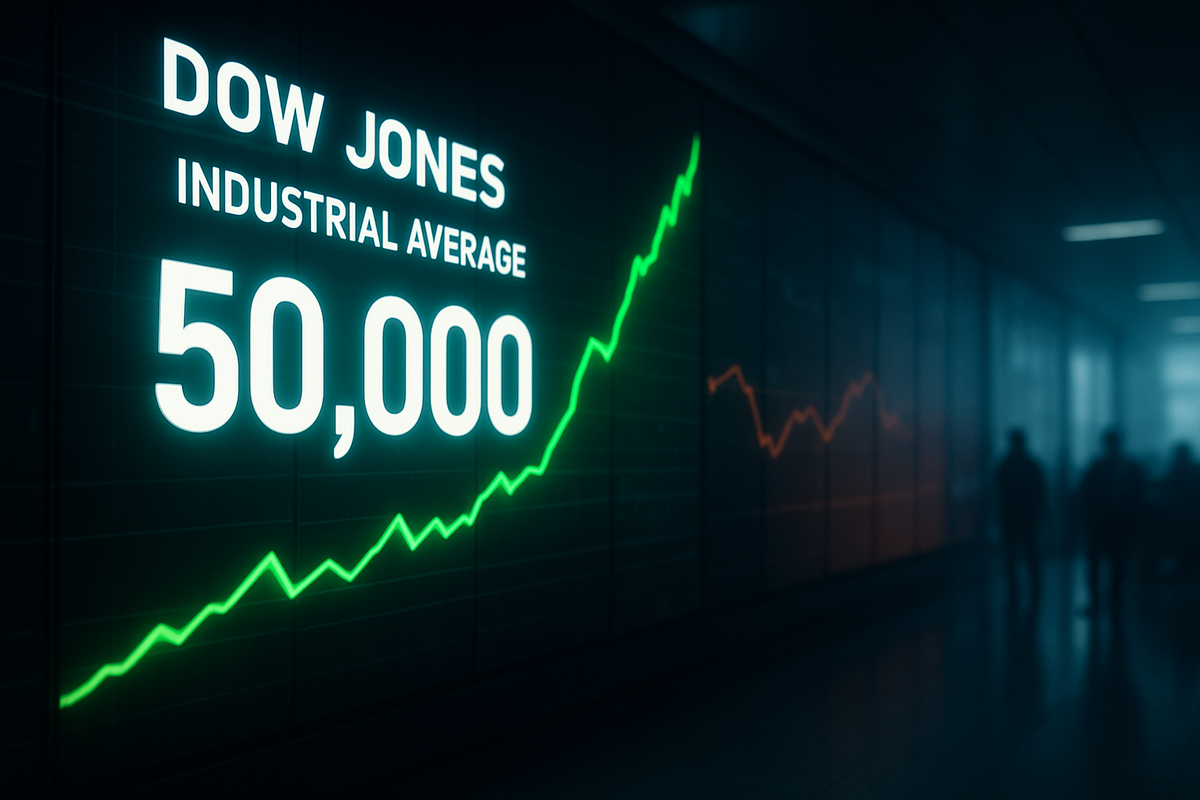
The financial world witnessed a watershed moment in early February 2026 as the Dow Jones Industrial Average (DJI) finally shattered the psychological 50,000-point barrier, marking the fastest 10,000-point ascent in the index's 130-year history. This "Infrastructure Milestone" saw the blue-chip index reach a staggering intraday peak of 50,512, driven by a powerful "Blue-Chip Renaissance" that prioritized industrial giants and financial bellwethers over high-flying software stocks. However, the euphoria proved short-lived as a cocktail of "sticky" inflation data, a resilient labor market, and concerns over high corporate capital expenditures triggered a sharp retreat, pulling the index back into its previous consolidation range of 48,500 to 49,600.
The breach of 50,000 represents more than just a round number; it symbolizes a market that has transitioned from the speculative AI fervor of 2024 into a "weighing machine" phase. While the milestone was greeted with cheers on the floor of the New York Stock Exchange, the subsequent stall suggests that investors are no longer willing to pay a premium for growth without immediate, tangible returns. As of mid-February 2026, the market is grappling with a "good news is bad news" paradox, where a strong economy is forcing the Federal Reserve to pause its long-awaited rate-cutting cycle, leaving the Dow in a precarious state of "cautious euphoria."
The Road to 50,000: A Timeline of the "February Frenzy"
The journey to 50,000 began in earnest during the final quarter of 2025, fueled by a rotation out of volatile tech stocks and into the Dow’s heavy-duty components. The official breach occurred on Friday, February 6, 2026, when the index surged 1,200 points in a single session to close at 50,115.67. This rally was largely powered by a "melt-up" in industrial stocks like Caterpillar Inc. (NYSE: CAT), which had recently reported record revenues of $19.1 billion, driven by a global surge in power generation demand for AI data centers. By the following Tuesday, the index hit its all-time high of 50,512, as momentum-driven algorithms and retail FOMO (fear of missing out) pushed valuations to their limits.
However, the tide began to turn on February 10, 2026, when a disappointing retail sales report showed that consumer spending had flatlined in December, despite the holiday season. This was followed by a series of macro shocks: the January Jobs Report on February 11 showed an unexpected addition of 130,000 jobs, while the February 13 CPI report revealed that "sticky" shelter and appliance costs kept headline inflation at 2.4%. This data effectively killed hopes for a March interest rate cut from the Federal Reserve, prompting a sharp reversal. By February 16, 2026, the Dow had retreated below the 50,000 mark, settling back into the 48,500-49,600 range that had defined the market's consolidation for much of the previous winter.
Key stakeholders, including institutional asset managers and pension funds, have spent the last week rebalancing portfolios. Goldman Sachs Group Inc. (NYSE: GS) analysts warned that the market had entered a period of "Adult Swim," where automated Commodity Trading Advisor (CTA) funds were poised to trigger billions in sell orders if the index failed to hold the 49,600 support level. This technical pressure, combined with a "prove it" earnings season, has replaced the early February optimism with a sober assessment of corporate margins and interest rate realities.
Winners and Losers: The "Blue-Chip Renaissance" vs. The "SaaSpocalypse"
The push to 50,000 highlighted a stark divergence between traditional industrial powerhouses and the software-heavy tech sector. The clear winners in this cycle have been the companies building the physical infrastructure of the 2020s. Caterpillar Inc. (NYSE: CAT) emerged as the primary engine of the Dow’s ascent, with its shares climbing over 30% in the first six weeks of 2026. Similarly, Nvidia Corp. (NASDAQ: NVDA), which was added to the Dow in late 2024, provided the necessary high-octane growth, reaching a market valuation of $4.5 trillion on the day the 50,000 mark was first crossed. These companies benefited from a shift in investor focus from AI users to AI builders.
On the losing side, Apple Inc. (NASDAQ: AAPL) and Boeing Co. (NYSE: BA) acted as significant drags on the index. Apple has struggled throughout 2025 and early 2026 due to its heavy exposure to trade tariffs and a "Siri Revolution" that has yet to convince skeptical consumers. Meanwhile, Boeing reported what analysts called a "profit illusion"—a massive earnings-per-share beat that was actually driven by the one-time sale of its digital aviation business rather than core operational success. The aerospace giant continues to face scrutiny over a $600 million charge on its KC-46 tanker program, making it one of the Dow's most volatile and unloved components in this current retreat.
Financial giants like JPMorgan Chase & Co. (NYSE: JPM) also faced headwinds during the retreat. While the bank initially posted strong earnings, its 2026 outlook was dampened by a $105 billion expense projection—a $9 billion increase from the previous year—attributed to massive internal AI infrastructure investments. Furthermore, a new regulatory proposal to cap credit card interest rates at 10% has triggered a rotation out of megabanks, contributing to the Dow’s inability to sustain its position above 50,000.
Analyzing the Significance: The Infrastructure Milestone and Policy Shifts
The Dow’s brush with 50,000 fits into a broader industry trend toward "AI Realism." In 2024 and 2025, the market was driven by the promise of artificial intelligence; in 2026, it is being driven by the cost of it. This shift has led to what some analysts call the "SaaSpocalypse," where software-as-a-service companies are seeing their valuations slashed as investors realize that AI might disrupt their business models faster than it enhances them. The Dow’s heavy weighting toward industrial and financial bellwethers has allowed it to outperform the tech-heavy Nasdaq during this transition, marking a historical precedent similar to the "old economy" resurgence seen after the dot-com bubble burst in the early 2000s.
Furthermore, the "Trump Tariff" volatility of 2025 has left a lasting impact on how these 30 blue-chip companies operate. The Dow’s recovery to 50,000 was partly a reflection of major corporations successfully diversifying their supply chains away from high-tariff regions. However, the "tariff pass-through" effects are now showing up in the CPI data, creating a policy headache for the Federal Reserve. If inflation remains "sticky" because of trade costs, the Fed may be forced to keep interest rates at 5% or higher indefinitely, a scenario that the market has not yet fully priced in.
The broader ripple effects are also being felt by competitors and partners of the Dow 30. As companies like Microsoft Corp. (NASDAQ: MSFT) surge their AI capital expenditures to nearly $40 billion a year, they are sucking liquidity out of other sectors. This "capital gravity" is making it harder for small-cap companies to compete for investment, further entrenching the dominance of the Dow's largest components and creating a "winner-take-all" environment in the U.S. equities market.
The Path Forward: Consolidation or Correction?
What comes next for the Dow depends largely on whether the current retreat into the 48,500-49,600 range is a "healthy pause" or the start of a more significant correction. In the short term, the market is likely to remain range-bound as it awaits more definitive data on consumer health. If retail sales continue to miss expectations, the "soft landing" thesis that propelled the Dow to 50,000 could be called into question. Strategic pivots will be required for tech giants like Microsoft, which must now demonstrate that its massive CapEx will lead to margin expansion rather than margin compression.
Market opportunities may emerge in defensive sectors that have been overlooked during the AI frenzy. Consumer staples and utilities are beginning to see inflows as investors seek shelter from the "Adult Swim" volatility of the broader market. Conversely, the challenge for the Dow will be overcoming the "psychological magnet" of 50,000. Historically, when an index breaches a major round number and fails to hold it, that level becomes a significant point of resistance that can take months or even years to definitively overcome.
Potential scenarios range from a "melt-down" if the Fed turns hawkish to a "slow grind" back toward the highs if corporate earnings in the second quarter of 2026 show that the AI infrastructure investments are finally paying off. Investors should also keep a close eye on the 2026 midterm election cycle, as political rhetoric regarding trade and corporate taxes will likely inject a fresh dose of volatility into the market by the third quarter.
Closing Thoughts for the Modern Investor
The Dow Jones Industrial Average hitting 50,000 was a moment of triumph for the "Blue-Chip Renaissance," but its quick retreat serves as a reminder that milestones are not foundations. The key takeaway for investors is that the "easy money" phase of the post-2024 recovery is over. The market has moved from rewarding growth-at-any-cost to demanding fundamental efficiency and clear pathways to profitability in an era of higher-for-longer interest rates and shifting trade dynamics.
Moving forward, the 50,000 level will likely serve as a ceiling that the market will test repeatedly in the coming months. The real test of the Dow's strength will not be how fast it can hit 51,000, but how well it can defend the 48,000 level in the face of economic headwinds. The significance of this event lies in the transition it represents: a market that is maturing, becoming more discerning, and finally acknowledging the physical and fiscal costs of the technological revolution it so eagerly embraced.
This content is intended for informational purposes only and is not financial advice.