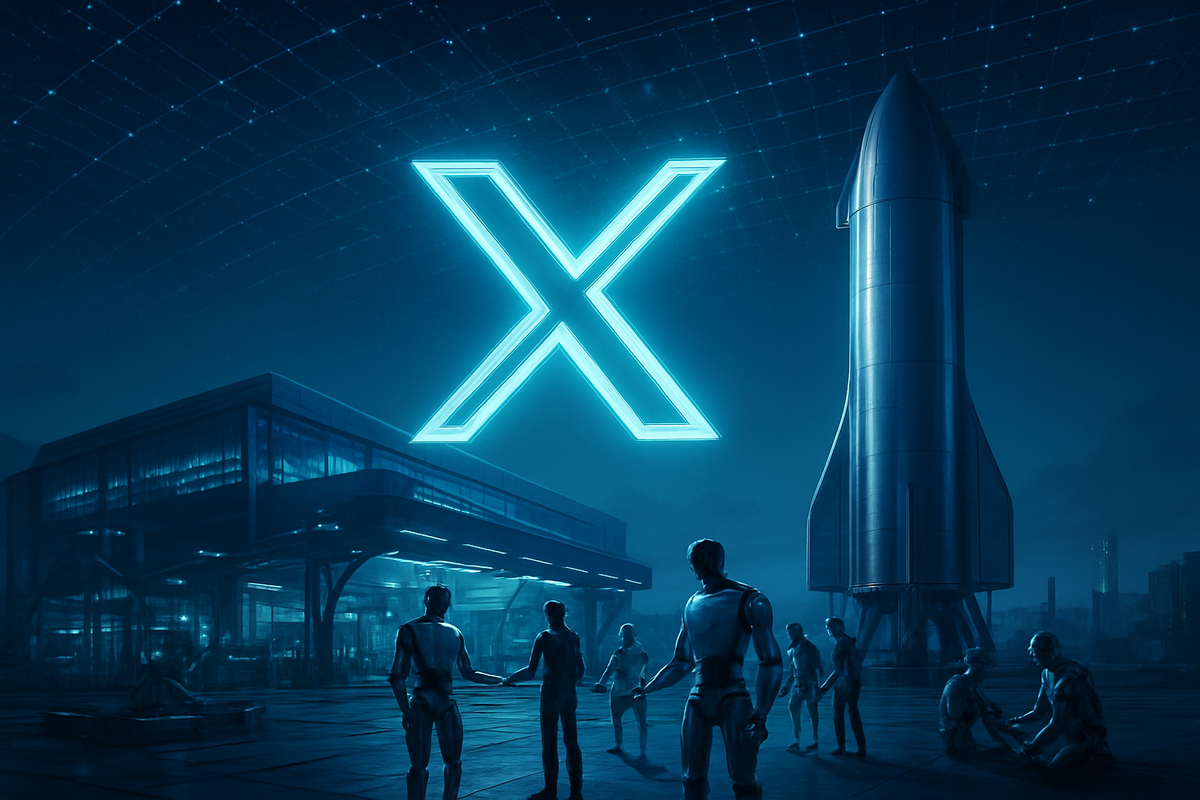
The year 2026 has opened with a seismic shift in the global technology landscape as rumors intensify surrounding Elon Musk’s long-teased "Everything Company." Recent reports and corporate filings suggest that the billionaire entrepreneur is moving toward a massive consolidation of his primary ventures, potentially merging the aerospace giant SpaceX with the artificial intelligence firm xAI, and integrating both more closely with Tesla, Inc. (NASDAQ: TSLA). This move, which many are calling the formation of "X Holdings," represents a strategic attempt to unify Musk’s disparate empire into a single, vertically integrated powerhouse of physical and digital intelligence.
The immediate implications of such a consolidation are profound, suggesting a future where orbital infrastructure, autonomous robotics, and advanced generative AI operate under a unified balance sheet. For the markets, the prospect of SpaceX—currently the world’s most valuable private company—nearing a public debut through this structural realignment has sent ripples through both the private equity and public sectors, signaling the most significant corporate restructuring of the decade.
The Birth of the Muskonomy: Nevada Filings and the Path to X Holdings
The rumors reached a fever pitch following the discovery of corporate filings in Nevada on January 21, 2026. Two new entities, labeled "X-A Merger Sub" and "X-S Merger Sub," were registered with the state, listing SpaceX Chief Financial Officer Bret Johnsen as an officer. These "merger subsidiaries" are classic indicators of a planned stock-for-stock swap or a complex acquisition structure. The timing coincides with Musk’s appearance at the 2026 World Economic Forum in Davos, where he hinted that "the economics of AI favor high-altitude or orbital compute," sparking speculation that xAI’s "Grok" models could soon be hosted on a dedicated fleet of Starlink satellites.
This strategic pivot follows a flurry of financial activity in late 2025. In December, SpaceX was valued at approximately $800 billion in private secondary markets, while xAI closed a massive $20 billion Series E funding round in early January 2026, which included controversial $2 billion investments from both Tesla and SpaceX. This interconnected funding created a "web of ownership" that analysts believe Musk is now looking to formalize. The timeline points toward a mid-2026 IPO for the unified SpaceX entity, with internal targets reportedly seeking a staggering $1.5 trillion valuation, rivaling the current market capitalization of Tesla itself.
The initial reaction from the investor community has been a mixture of awe and apprehension. Tesla (NASDAQ: TSLA) shares climbed 4.5% in the week following the Nevada filings, as retail investors cheered the prospect of Tesla gaining a direct stake in SpaceX’s launch dominance. However, institutional governance experts have raised red flags. The potential for "self-dealing"—where Musk essentially negotiates with himself to set the terms of the merger—remains a central point of contention for those concerned with fiduciary responsibility.
Winners and Losers: The Stakes for Shareholders and Competitors
The primary "winner" in this consolidation appears to be the Tesla (NASDAQ: TSLA) retail investor base, which has long clamored for exposure to SpaceX. If Tesla is folded into or becomes a primary partner in the X Holdings umbrella, it could benefit from a "halo effect" provided by SpaceX’s high-margin Starlink business. Furthermore, the integration of xAI’s large language models could accelerate Tesla’s "Physical AI" projects, such as the Optimus humanoid robot and its long-awaited Robotaxi fleet, which saw a successful limited rollout in select cities in late 2025.
On the other hand, early SpaceX venture capital investors may face a more complex outcome. While a merger provides a path to liquidity, many private equity firms joined SpaceX for its aerospace purity, not to have their returns tethered to the volatility of a public automaker or a nascent AI startup. Similarly, traditional aerospace competitors like Boeing (NYSE: BA) and Lockheed Martin (NYSE: LMT) face a daunting new reality: a competitor that doesn't just launch satellites but owns the AI that processes the data and the robotics that build the hardware, all under one financial roof.
The "losers" in this scenario could also include regulatory watchdogs. If Musk succeeds in creating a closed-loop ecosystem—where Tesla cars provide the data, xAI provides the intelligence, and SpaceX provides the global connectivity—it becomes nearly impossible for any single-sector competitor to break into the market. This "walled garden" approach has already drawn the attention of antitrust advocates who argue that the consolidation of data and infrastructure at this scale creates a monopoly on the future of autonomous systems.
A New Corporate Paradigm: Synergies and Regulatory Gauntlets
This event is more than just a corporate merger; it is the culmination of a broader industry trend toward "Vertical Intelligence." Just as Apple (NASDAQ: AAPL) consolidated its software and hardware, Musk is attempting to consolidate the physical world (Tesla), the digital world (xAI), and the connective tissue between them (SpaceX/Starlink). The synergy of "Orbital Computing" is the most tangible benefit: by moving xAI’s compute clusters into space, Musk can bypass traditional power grid constraints and cooling costs on Earth, using the cold of the vacuum and solar energy to power the next generation of LLMs.
However, the regulatory hurdles are unprecedented. The Federal Trade Commission (FTC) and the Securities and Exchange Commission (SEC) are expected to scrutinize the "self-dealing" aspects of the merger. Because Musk owns a higher percentage of the private SpaceX and xAI than he does of the public Tesla, any merger ratio that favors the private entities could be viewed as a transfer of wealth from public shareholders to Musk personally. Furthermore, because SpaceX is a critical defense contractor for the Pentagon, the Committee on Foreign Investment in the United States (CFIUS) will likely investigate whether integrating a consumer-facing AI like Grok into classified launch systems poses a national security risk.
The historical precedent for such a move is sparse. It is perhaps most comparable to the 19th-century railroad and steel trusts, where a single individual controlled every step of the industrial process. In the modern era, the closest comparison is Alphabet’s (NASDAQ: GOOGL) formation to oversee Google’s moonshots, but even that lacked the heavy industrial and defense-contracting weight that a Musk-led X Holdings would possess.
The Road Ahead: Short-Term Pivots and Long-Term Dominance
In the short term, the market should prepare for a period of extreme volatility. The "X Holdings" transition will require a massive internal reorganization and likely a series of shareholder votes that will be fiercely contested. Tesla (NASDAQ: TSLA) will need to justify its $2 billion investment into xAI to a Delaware court, which is still overseeing derivative lawsuits from 2024. If the merger is finalized by the rumored June 2026 deadline, the resulting entity would instantly become one of the top five most valuable companies in the world.
Looking further ahead, the long-term strategic pivot involves the "Robotics-as-a-Service" (RaaS) model. A merged SpaceX-Tesla-xAI entity could theoretically deploy Optimus robots globally, controlled via Starlink and powered by xAI, creating a workforce that is independent of local infrastructure. The market opportunity for such a fleet is estimated in the tens of trillions, though the societal and ethical challenges of such a monopoly would likely trigger a new wave of global regulation and policy debates.
Final Assessment: What Investors Should Watch
The rumored consolidation of the "Muskonomy" represents a high-stakes gamble on the future of human enterprise. If successful, it creates a company with a moat so wide it encompasses the very orbit of the planet. For investors, the takeaway is clear: the era of Musk’s companies operating as separate silos is ending. The "X Holdings" vision is an all-or-nothing bet on the convergence of AI, space, and robotics.
In the coming months, investors should keep a close eye on any further SEC filings from Tesla regarding "related party transactions" and monitor the progress of the SpaceX IPO preparations. The pricing of SpaceX private shares will be the ultimate bellwether for how the market values this new "Everything Company." While the potential for growth is astronomical, the regulatory and governance risks are equally vast. As we move deeper into 2026, the question is no longer whether Elon Musk can disrupt individual industries, but whether he can merge them into a singular, unstoppable force.
This content is intended for informational purposes only and is not financial advice.