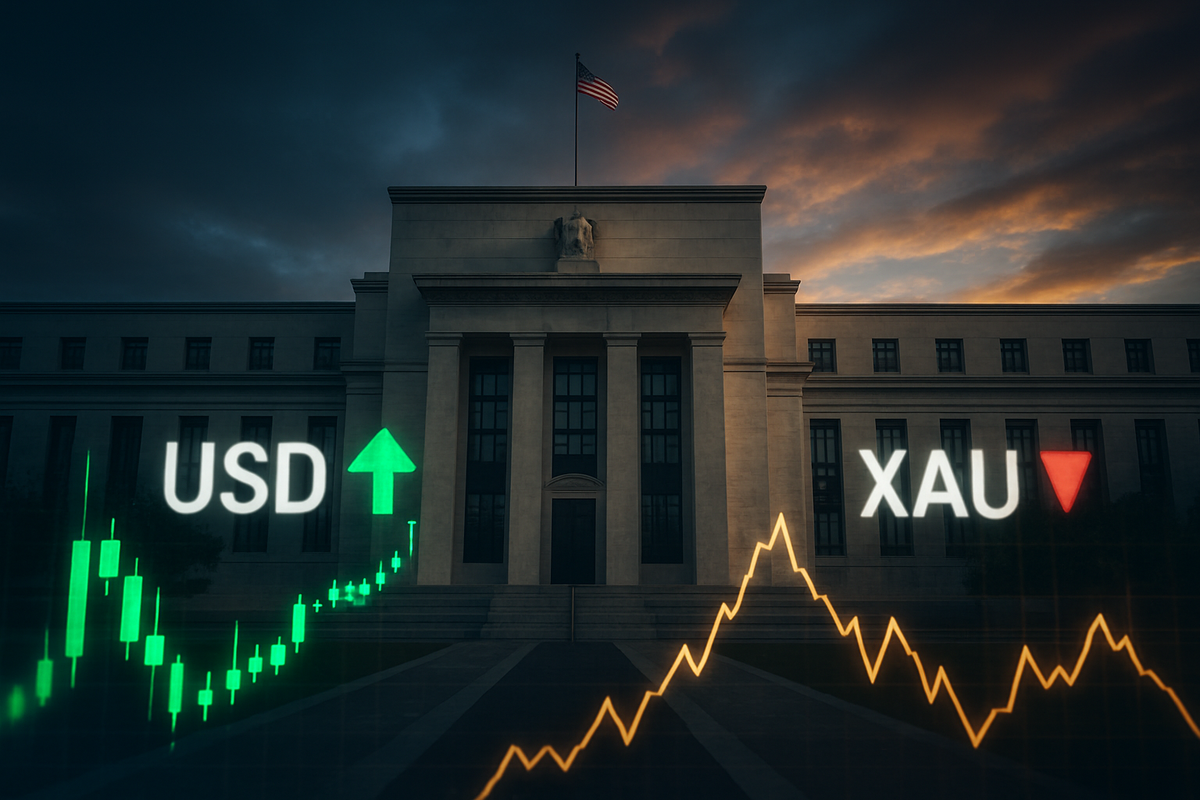
On January 30, 2026, the financial landscape underwent a seismic shift as President Donald Trump officially announced his nomination of former Federal Reserve Governor Kevin Warsh to succeed Jerome Powell as the next Chair of the Federal Reserve. The announcement, delivered via a series of posts on Truth Social, characterizes Warsh as the ideal candidate to balance aggressive deregulation with a strategic pivot in monetary policy. The immediate market response was a cocktail of volatility: the U.S. Dollar Index (DXY) climbed as traders priced in a "new regime" of central banking, while precious metals experienced a dramatic sell-off, with gold falling nearly 5% in a matter of hours.
The nomination sets the stage for a high-stakes transition when Chair Powell’s term expires in May 2026. While the market initially reacted to the "hawkish" credibility Warsh built during his tenure from 2006 to 2011, the long-term implications are far more complex. Analysts are now wrestling with the prospect of a Fed leader who has recently called for lower interest rates while simultaneously advocating for a much more aggressive reduction of the Fed’s $6.5 trillion balance sheet—a policy combination that could redefine the value of the U.S. Dollar and the cost of capital for years to come.
A High-Stakes Nomination Amid Political Turbulence
The path to Warsh’s nomination has been paved by months of speculation and a deteriorating relationship between the executive branch and the current Fed leadership. President Trump’s selection of Warsh, a move he described as finding "central casting" for the role, signals a desire to move away from the Powell era’s "higher-for-longer" interest rate philosophy. Warsh, who rose to prominence as a young Fed Governor during the 2008 financial crisis and later became a vocal critic of the central bank's ultra-loose policies, is seen as a figure who can bridge the gap between Wall Street pragmatism and the administration’s pro-growth agenda.
However, the nomination is not without its immediate hurdles. Despite a Republican majority in the Senate, the confirmation process is already facing a significant roadblock. Senator Thom Tillis (R-NC) has stated he will block any nominee until the Department of Justice clarifies a "criminal investigation" into Jerome Powell regarding past congressional testimony. This internal party friction introduces a layer of political risk that initially spooked the bond markets, pushing the 10-year Treasury yield to 4.26% as investors began demanding a higher premium for the uncertainty surrounding the leadership transition.
The market reaction on the day of the announcement was swift and severe. Precious metals, which often serve as a hedge against inflation and dollar weakness, bore the brunt of the news. Gold plummeted to approximately $5,130 per ounce, and silver tumbled over 10%. This "flash crash" suggests that investors are currently betting on a "Warsh Dollar" that remains strong in the short term, fueled by his reputation as an institutionalist who values currency stability and Fed independence, even as he entertains the idea of lower borrowing costs.
Corporate Winners and Strategic Losers in the Warsh Era
The transition to a Warsh-led Federal Reserve creates a distinct set of winners and losers across the corporate landscape. Among the immediate winners are regional banking institutions, often tracked via the SPDR S&P Regional Banking ETF (NYSEARCA:KRE). Warsh has been a vocal critic of the Dodd-Frank Act, arguing that its regulatory burden has stifled smaller banks. His expected push for "tailored" regulation and a more lenient stance on bank consolidation could spark a new wave of M&A activity, benefiting giants like JPMorgan Chase (NYSE: JPM) and Bank of America (NYSE: BAC) while providing a lifeline to mid-sized lenders.
Conversely, the nomination has placed significant pressure on the tech and growth sectors. Companies like Microsoft (NASDAQ: MSFT) and Apple (NASDAQ: AAPL) saw their share prices dip as the market grappled with the prospect of a steepening yield curve. If Warsh successfully couples lower short-term rates with aggressive Quantitative Tightening (QT)—selling off the Fed’s massive holdings of Treasury and mortgage-backed securities—long-dated yields could remain elevated. This scenario is particularly punishing for high-growth tech firms whose valuations are highly sensitive to long-term discount rates.
The nomination also carries direct implications for companies where Warsh has personal or professional ties. United Parcel Service (NYSE: UPS), where Warsh serves on the Board of Directors, will likely see a board vacancy as he moves toward confirmation. Meanwhile, Estée Lauder (NYSE: EL) may face increased public scrutiny due to Warsh’s marriage to Jane Lauder, an heiress to the cosmetics giant. In the commodities sector, mining stocks such as Newmont (NYSE: NEM) and Fresnillo (LSE:FRES) were among the day's biggest losers, as the strengthening dollar and the crash in bullion prices decimated their short-term revenue outlook.
Redefining Central Bank Independence and Strategy
The broader significance of the Warsh nomination lies in the potential for a fundamental shift in how the Federal Reserve operates within the global economy. For the past decade, the Fed has largely followed a "consensus-driven" approach, focusing on gradual adjustments to the federal funds rate. Warsh represents a more radical departure, often advocating for the Fed to shrink its "footprint" in financial markets. His focus on reducing the balance sheet—which he calls a "relic of crisis-era thinking"—suggests a future where the Fed provides less liquidity to the markets, potentially leading to higher volatility but more "honest" price discovery.
This shift fits into a wider industry trend where central banks are increasingly being pressured to align with national industrial policies. While Warsh is a staunch advocate for Fed independence, his recent rhetoric suggesting that the Fed was "too late" to cut rates aligns him with the current administration's goals. This creates a "credibility paradox": if the market perceives Warsh as being too closely aligned with the White House, long-term inflation expectations could rise, paradoxically driving up the very mortgage and consumer loan rates the administration seeks to lower. Mortgage-heavy firms like Rocket Companies (NYSE: RKT) and UWM Holdings (NYSE: UWMC) are particularly vulnerable to this risk, as their business models rely on stable, long-term interest rate environments.
Furthermore, Warsh’s stance on digital assets could reshape the financial technology sector. He has expressed opposition to a "retail" Central Bank Digital Currency (CBDC), citing privacy concerns, but has voiced support for a "wholesale" CBDC to modernize the interbank clearing system. This nuanced approach could provide a tailwind for private-sector stablecoin issuers and blockchain infrastructure companies, while signaling a "hands-off" approach to individual consumer digital wallets, a sharp contrast to the digital currency explorations seen in Europe and China.
The Long Road to May 2026: What Lies Ahead
In the short term, the primary focus for the markets will be the Senate confirmation hearings. Investors will be watching closely for any sign that the "Tillis Hold" might break or if other Republican senators voice concerns over Warsh’s past criticisms of the administration’s tariff policies. Any delay in the confirmation process is likely to cause further volatility in the U.S. Dollar as the market hates a leadership vacuum, especially at an institution as vital as the Federal Reserve.
If confirmed, the transition in May 2026 will require a strategic pivot from nearly every major financial institution. Banks and hedge funds will need to adapt to a "smaller balance sheet" environment where the Fed is no longer the "buyer of last resort" for Treasuries. This could lead to a period of higher repo market volatility and a demand for higher liquidity buffers at private banks. Additionally, the long-term trajectory of the U.S. Dollar remains a major question mark; while the initial reaction was positive, a Warsh-led Fed that successfully lowers rates while the rest of the world remains in a high-inflation environment could eventually lead to a softer dollar, benefiting U.S. exporters at the expense of global purchasing power.
Scenario planning for a "Warsh Fed" often includes a "Goldilocks" outcome—where aggressive deregulation and targeted rate cuts spur domestic growth without reigniting inflation. However, the more bearish scenario involves a "policy error" where rapid Quantitative Tightening drains too much liquidity from the system, leading to a credit crunch even as nominal rates fall. Market participants will be looking for clues in Warsh’s upcoming testimony regarding how he intends to balance these competing forces.
Summary and Investor Outlook
The nomination of Kevin Warsh represents a potential "regime change" at the Federal Reserve, moving away from the cautious, data-dependent approach of Jerome Powell toward a more proactive, balance-sheet-focused strategy. The initial market reaction—a surging dollar and a collapse in precious metals—highlights the magnitude of the shift. Investors have signaled that they expect a Warsh-led Fed to be more market-centric, potentially less regulatory-heavy, but also potentially more politically integrated than its predecessors.
Key takeaways for the coming months include:
- Watch the Yield Curve: The gap between short-term and long-term interest rates will be the ultimate barometer of market confidence in Warsh’s ability to manage inflation while cutting rates.
- Dollar Volatility: The U.S. Dollar (DXY) is likely to remain on an upward trajectory until the confirmation process is finalized, but long-term weakness could emerge if "lower rates" become the primary focus.
- Sector Rotation: Keep a close eye on regional banks and deregulation-sensitive sectors, which may outperform the broader tech-heavy indices as the "Warsh Era" approaches.
As the May 2026 transition date nears, the financial world will be watching every word from the nominee. Whether Warsh can successfully navigate the tightrope between institutional independence and political pressure will likely define the U.S. economic narrative for the next four years.
This content is intended for informational purposes only and is not financial advice.