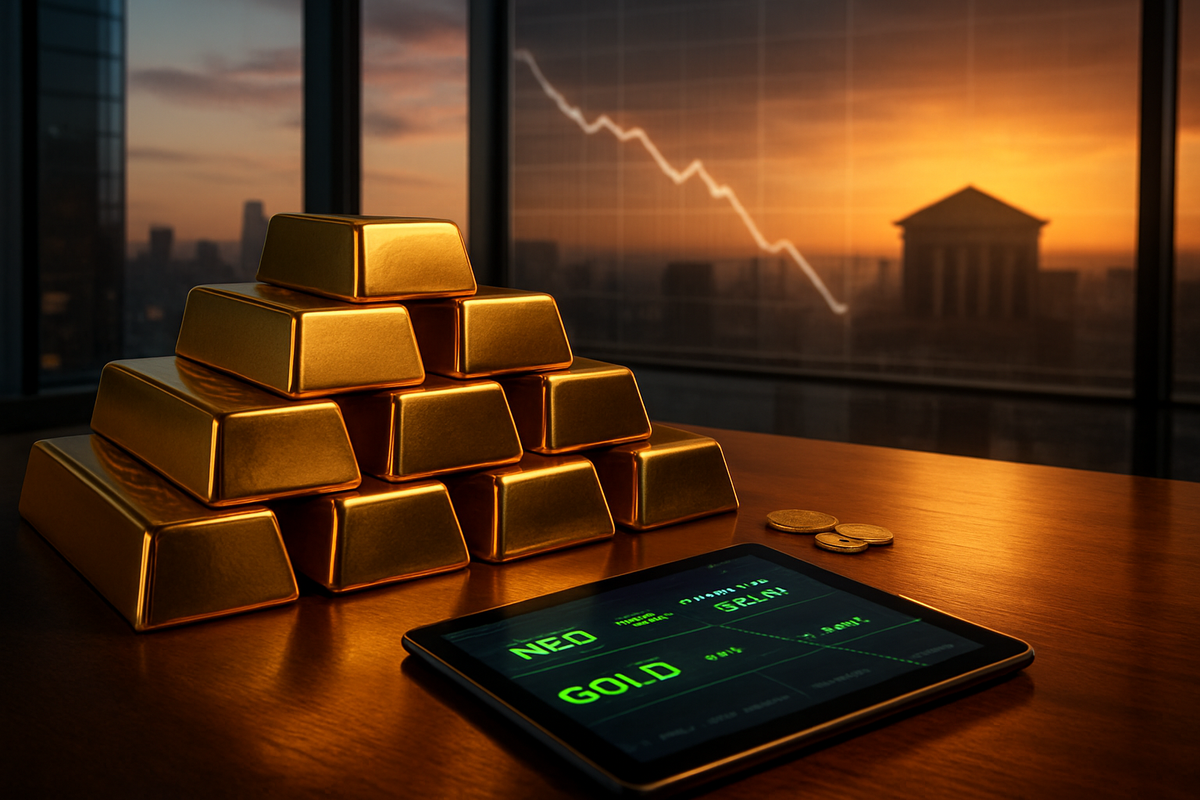
As the final bells of 2025 ring across global exchanges, gold has solidified its status as the year’s premier asset class, ending the annual session with gains exceeding 60%. This historic rally, which saw spot prices touch an all-time high near $4,560 per ounce in late December, has been driven by a fundamental shift in U.S. monetary policy and a resurgence of safe-haven demand. However, the final trading sessions of December have seen a modest retreat from those peaks, as institutional traders and retail investors alike engage in aggressive year-end profit-taking to lock in the most substantial precious metal gains in decades.
The immediate implications of this rally are profound, signaling a broader market pivot away from traditional fixed-income assets and toward "hard money" hedges. As the Federal Reserve transitioned from a restrictive stance to an active easing cycle in the latter half of the year, the opportunity cost of holding non-yielding bullion plummeted. This shift has not only reshaped investor portfolios but has also provided a massive windfall for the global mining sector, even as other industries struggle under the weight of persistent, tariff-driven inflation.
The Perfect Storm: Rate Cuts, Tariffs, and a Data Blackout
The narrative of the 2025 gold rally is inextricably linked to the Federal Reserve's dramatic policy reversal. After maintaining a "higher for longer" interest rate environment for much of 2024, the central bank initiated a series of three 25-basis-point cuts beginning in September 2025. These moves brought the federal funds rate down to a target range of 3.50% to 3.75% by year-end. The easing cycle was met with significant internal dissent—a 9-3 vote in December—reflecting a central bank torn between cooling economic growth and "sticky" core inflation that remained stubbornly above the 2.5% mark.
A critical catalyst for the late-year surge was the unprecedented six-week U.S. government shutdown in late 2025. This "data blackout" halted the release of essential economic indicators, including Consumer Price Index (CPI) and employment reports, leaving the Fed and market participants to operate in an informational vacuum. In the absence of reliable data, investors fled to the certainty of gold, pushing the metal above the psychological $4,000 threshold. Furthermore, the implementation of broad-based reciprocal tariffs sparked fears of a renewed inflationary spiral, further cementing gold’s role as a primary hedge against currency debasement.
Central banks also played a pivotal role in maintaining the rally’s momentum. While the pace of buying slowed slightly at record-high prices, institutions in Poland, India, and Turkey remained aggressive accumulators. The strategic shift toward de-dollarization accelerated as emerging markets sought to diversify their reserves away from U.S. Treasuries, which faced their own volatility as the 10-year yield remained stubbornly high near 5%, despite the Fed's short-term rate cuts.
Winners and Losers: A Tale of Two Markets
The 2025 gold rush created a sharp divide between the "haves" and the "have-nots" in the equity markets. The clear victors were the major gold producers, who saw their margins expand at an astronomical rate as the spot price of gold outpaced operational costs. Newmont (NYSE: NEM), the world’s largest gold miner, saw its stock surge by more than 180% year-to-date, supported by a credit upgrade and record-breaking cash flows. Similarly, Barrick Gold (NYSE: GOLD) outperformed the broader sector, leveraging its massive production scale to execute significant share buybacks and dividend increases.
Agnico Eagle Mines (NYSE: AEM) also emerged as a top performer, with its stock rising over 100% in 2025. By maintaining a "no-hedge" policy, Agnico Eagle was able to capture the full upside of the price surge, reporting record adjusted net income and transitioning to a robust net cash position by the third quarter. These companies have effectively become cash-flow machines, providing a rare bright spot in a year where broader market indices struggled to keep pace with inflation.
Conversely, the year was punishing for sectors sensitive to high costs and shifting consumer habits. Consumer discretionary giants like Nike (NYSE: NKE) and Lululemon (NASDAQ: LULU) faced significant headwinds as "tariff turmoil" and high borrowing costs squeezed household budgets. The jewelry industry also felt the sting; mid-tier retailers like Signet Jewelers (NYSE: SIG) struggled as the skyrocketing cost of raw gold made traditional products unaffordable for the average consumer, leading to a sharp decline in sales volume.
Wider Significance: A Return to the 1970s?
The magnitude of the 2025 rally has invited comparisons to the stagflationary era of the 1970s. Like that period, 2025 was characterized by a combination of geopolitical instability—highlighted by the U.S. naval blockade of Venezuela—and a fundamental questioning of the U.S. dollar's role as the world's primary reserve currency. The "debasement trade" became the dominant theme of the year, as investors moved to protect their purchasing power against a backdrop of rising fiscal deficits and trade-related price shocks.
This event also signals a structural shift in how gold is perceived by institutional investors. Long viewed as a "relic" or a niche hedge, gold-backed ETFs saw record inflows of over $20 billion in 2025, suggesting that the metal has regained its status as a core portfolio component. The ripple effects are being felt across the commodities complex, with silver and platinum also seeing significant gains as industrial and speculative demand converged.
The Road Ahead: 2026 and Beyond
As we move into 2026, the primary question for investors is whether the current retreat is a temporary pause or the beginning of a larger correction. In the short term, the market will be focused on the Fed's next moves; any sign of a pause in the rate-cutting cycle could lead to further profit-taking. However, if inflation remains sticky or if geopolitical tensions in South America and the Middle East escalate further, the floor for gold prices is likely to remain high.
Strategic pivots will be required for companies on both sides of the gold trade. Miners must manage the risk of rising labor and energy costs, which could eventually begin to eat into their record margins. Meanwhile, consumer-facing companies will need to adapt to a "high-cost" reality, perhaps by innovating with alternative materials or focusing on ultra-luxury segments that are less sensitive to price fluctuations.
Final Thoughts: Reflecting on the Year of Gold
The 2025 gold rally will be remembered as a watershed moment for global finance. It was a year that tested the limits of central bank policy and reaffirmed the enduring value of tangible assets in an era of economic and digital uncertainty. With gains of over 60%, gold has not only protected wealth but has also redefined the parameters of a "safe-haven" asset in the modern age.
Moving forward, investors should keep a close eye on the resolution of the U.S. tariff policies and the stability of the global trade system. While the current year-end profit-taking is a natural reaction to a historic run, the underlying drivers of the gold rally—debt, inflation, and geopolitical realignment—show no signs of vanishing. As we enter 2026, the "Golden Standard" remains the benchmark for a market in transition.
This content is intended for informational purposes only and is not financial advice.