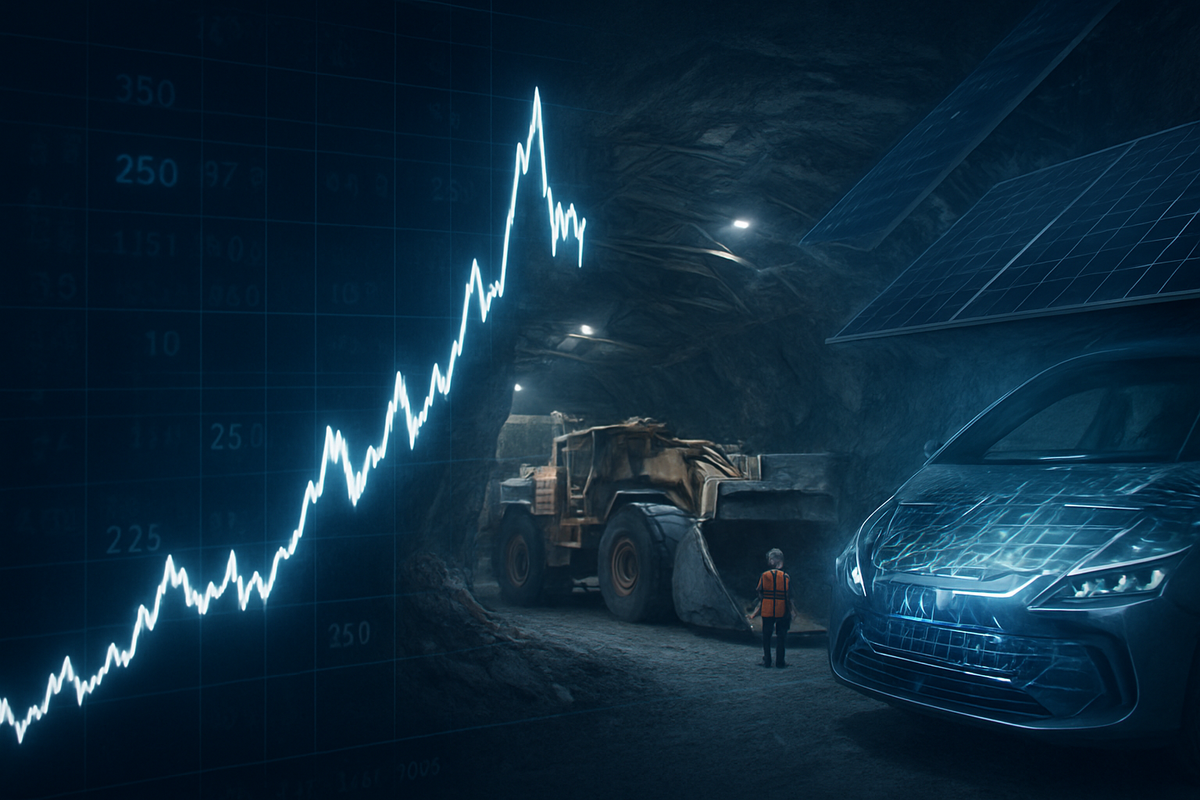
As the curtain closes on 2025, the silver market stands as one of the most remarkable—and exhausting—financial stories of the year. After a decade of trading in the shadow of gold, silver finally broke its chains this year, catapulting from under $30 an ounce to a historic peak that shattered 45-year-old records. However, the journey has been anything but smooth; the "Devil’s Metal" lived up to its reputation for extreme volatility, ending the year with a series of sharp intraday swings that have left even the most seasoned precious metals investors reaching for the smelling salts.
For major producers like Hecla Mining (NYSE: HL), the year has been a masterclass in operational agility. While the soaring price of silver has padded balance sheets and allowed for significant debt reduction, the underlying market mechanics—driven by a deepening structural deficit and a sudden "short squeeze" in December—have created a complex environment. As we reach December 31, 2025, the industry is grappling with the duality of record-breaking revenues and the logistical headaches of a market where physical supply is increasingly decoupled from paper prices.
The 2025 Silver Squeeze and the Path to $50
The silver market began 2025 with quiet confidence, building on a late-2024 base of approximately $29.68 per ounce. However, as the global industrial sector accelerated its transition toward high-efficiency solar panels and electric vehicle (EV) infrastructure, the narrative shifted from speculative interest to physical necessity. By mid-year, silver had breached $35, and by October, it finally eclipsed its legendary 1980 high of $49.95, reaching a nominal peak of $54.46. The momentum culminated in a chaotic December, where a combination of thin holiday liquidity and a scramble for physical delivery saw intraday spikes toward $80 before a sharp 7% correction cooled the market.
This timeline was accelerated by several key catalysts. Throughout the first half of the year, the Federal Reserve’s pivot toward a more neutral monetary stance weakened the dollar, providing a tailwind for all precious metals. Simultaneously, the solar industry’s rapid adoption of TOPCon (Tunnel Oxide Passivated Contact) technology increased silver loading per cell by nearly 50%, creating a relentless bid for the metal. By the time China announced new export restrictions on refined silver in late 2025, the market was already in a state of high tension, leading to the dramatic price action seen in the year's final weeks.
Key stakeholders, including institutional bullion banks and retail "silver squeeze" advocates, found themselves in a high-stakes tug-of-war. The initial market reaction to the $50 breach was one of euphoria, followed quickly by concern as the CME Group (NASDAQ: CME) hiked margin requirements to curb the volatility. This move, while intended to stabilize the market, triggered a cascade of liquidations that contributed to the sharp pullbacks observed in late December, testing the resolve of investors who had entered the market at the top.
Operational Prowess: Hecla Mining and the Industry Leaders
Hecla Mining (NYSE: HL) has emerged as a primary beneficiary of this price environment, though not without its own set of hurdles. The company’s flagship Greens Creek mine in Alaska remained the "workhorse" of the portfolio, producing between 8.1 and 8.8 million ounces of silver at remarkably low costs. The resumption of full operations at the Lucky Friday mine in Idaho was equally critical, as the mine benefited from the new Underhand Closed Bench (UCB) mining method, which allowed for record throughput just as prices were peaking. By the end of 2025, Hecla’s consolidated production guidance of 16.2 to 17.0 million ounces placed it in a position of strength, allowing the company to reduce its net leverage ratio from 2.7x to a lean 0.7x.
However, the year also highlighted the risks inherent in mining. Hecla’s Keno Hill project in the Yukon, while reaching its first profitable quarter in early 2025, faced regional power curtailments due to hydroelectric failures. This forced management to pivot, adjusting throughput targets to prioritize high-grade profitability over sheer volume. Other major players faced similar mixed bags; Pan American Silver (NYSE: PAAS) saw its margins expand significantly but dealt with inflationary pressures on labor and energy, while Coeur Mining (NYSE: CDE) leveraged its expanded Rochester mine to capture the price surge, though it remained more sensitive to the year-end price swings due to its higher cost structure.
The "losers" in this environment have largely been the short-sellers and the industrial end-users who failed to hedge their silver requirements. Small-scale electronics manufacturers and some junior solar firms have reported significant margin compression as silver, which was once a negligible cost component, became a major line item. Conversely, First Majestic Silver (NYSE: AG) capitalized on the volatility by withholding some production from the market during the December dips, a strategic move aimed at selling into the subsequent recoveries—a luxury only available to companies with strong cash positions.
A Structural Shift: Beyond Industrial Basics
The wider significance of 2025 lies in the realization that silver is no longer just a "precious" metal; it is a critical industrial commodity essential for the green energy transition. The market faced its fifth consecutive year of structural deficit in 2025, with the shortfall estimated to be as high as 200 million ounces. This isn't a temporary glitch but a fundamental shift. The surge in demand from AI data centers—which require high-conductivity silver components for power infrastructure—added a new, unexpected layer of demand that the mining industry was not prepared to meet.
This event fits into a broader trend of "resource nationalism" and supply chain security. The Chinese export restrictions mentioned earlier served as a wake-up call for Western regulators, sparking discussions about adding silver to official "critical minerals" lists. Historically, silver has been treated as a byproduct of lead, zinc, and copper mining, meaning that even high prices don't immediately lead to new silver-only mines. This inelasticity of supply is a major departure from other commodities, where higher prices usually trigger a rapid supply response.
The ripple effects are being felt across the tech sector. Partners and competitors alike are now racing to find "thrifts"—ways to use less silver—but in high-performance applications like 5G and AI, the conductivity of silver remains unparalleled. This has led to a historical precedent where silver is beginning to trade more like a strategic industrial metal (similar to lithium or cobalt) rather than a mere monetary asset, a trend that is likely to persist as the world decarbonizes.
The Road Ahead: 2026 and Strategic Pivots
Looking toward 2026, the silver market is entering a phase of consolidation and strategic adaptation. In the short term, the market will likely spend the first quarter of the new year digesting the massive gains of 2025. Investors should expect continued volatility as the "paper" and "physical" markets continue to reconcile. For companies like Hecla, the focus will shift from simply maximizing production to "smart growth"—investing in exploration around existing hubs like Greens Creek to extend mine life without the massive capital expenditure required for greenfield projects.
Strategic pivots will be required for industrial consumers, who may begin to seek long-term offtake agreements directly with miners like Mag Silver (NYSE: MAG) or Hecla to bypass the volatile spot market. We may also see an increase in silver recycling initiatives, though the low concentration of silver in individual electronic devices makes this a long-term challenge rather than a quick fix. The primary scenario for 2026 is one of "higher for longer," where silver maintains a floor above $40 as the physical deficit continues to drain global warehouse stocks.
Conclusion: A New Era for the "Devil’s Metal"
The year 2025 has been a transformative one for the silver market and its primary producers. The key takeaway is the metal's successful transition into a dual-role asset: a safe haven in times of geopolitical tension and an indispensable component of the 21st-century economy. Hecla Mining (NYSE: HL) has proven that operational discipline and a focus on Tier-1 jurisdictions can provide a shield against market chaos, ending the year with its strongest balance sheet in recent memory.
Moving forward, the market is likely to remain tight. Investors should watch for updates on mine expansions, changes in Chinese trade policy, and the continued evolution of solar technology. While the price swings of late 2025 were nerve-wracking, they are a symptom of a market that is finally pricing in years of underinvestment and surging demand. For those who can stomach the volatility, the "Silver Era" appears to be just beginning.
This content is intended for informational purposes only and is not financial advice.