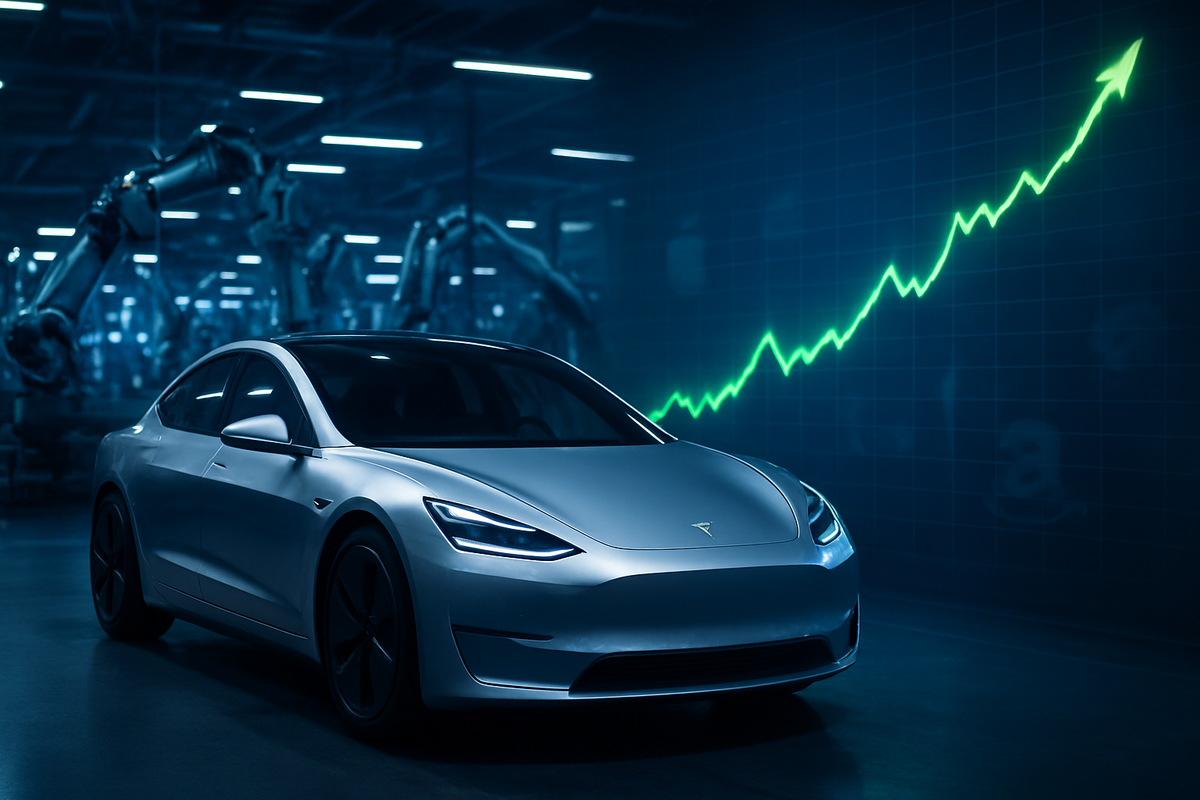
As the final trading days of 2025 wind down, Tesla (NASDAQ: TSLA) finds itself in a familiar position: at the center of a market-wide debate over its valuation. However, the narrative has shifted dramatically from the start of the year. While the broader "Magnificent 7" cohort has faced a cooling period characterized by "AI fatigue" and high capital expenditure concerns, Tesla has managed to decouple from its peers, trading near a record high of $480. This resurgence comes despite a year of extreme volatility and a significant contraction in the company's automotive margins.
The immediate implications are clear: investors are no longer valuing Tesla solely as a car manufacturer. The late-2025 rally reflects a growing market confidence in Tesla’s transition toward an AI and robotics-first business model. With the official production start of the "Model 2" and the expansion of the "Cybercab" pilot programs, the company is attempting to prove that it can maintain its premium valuation even as its core EV business faces a "demand cliff" following the expiration of federal tax incentives.
The Long Road Back: From Q1 Collapse to Record Highs
The timeline of 2025 for Tesla began in a state of crisis. In the first quarter of the year, the stock dipped below $150 as investors fretted over aging vehicle models and aggressive price cuts that gutted operating margins. At its lowest point, critics argued that Tesla’s business model was "broken," as it struggled to compete with lower-cost Chinese entrants. However, the tide began to turn following the October 2024 unveiling of the "Cybercab"—a two-seater robotaxi without a steering wheel or pedals—and the subsequent launch of supervised pilot programs in Austin and San Francisco by mid-2025.
Key to this recovery was the Q3 2025 earnings report, which revealed record revenue of $28.1 billion and a massive cash "war chest" of $41.6 billion. While operating margins remained under pressure—hovering between 5.1% and 7.2%—the market focused on the future. In December 2025, Tesla officially "cranked up" the production line for the long-awaited $25,000 vehicle, codenamed "Redwood" or the Model 2, at Giga Texas. This move, combined with a 45% to 75% recovery from yearly lows, pushed Tesla’s market capitalization back toward the $1.6 trillion mark, reaching an intraday high of $498.83.
The industry reaction has been polarized. While some analysts point to the "Model 2" as the ultimate volume driver that will democratize EVs, others remain skeptical of the timeline for "unsupervised" Level 4 autonomy. Currently, Tesla’s robotaxi fleet in Austin consists of roughly 200–300 units, significantly trailing the more established operations of competitors like Waymo.
Winners and Losers in the 2025 Tech Landscape
In the broader tech landscape, Tesla’s late-year surge stands in stark contrast to several of its "Magnificent 7" peers. Alphabet (NASDAQ: GOOGL) emerged as the definitive standout of 2025, with its stock up roughly 63% thanks to its AI search dominance and key legal victories. Nvidia (NASDAQ: NVDA) also continued its winning streak, gaining 37% as the demand for AI infrastructure showed no signs of abating. These three companies have effectively carried the market through a year where other tech giants stumbled.
On the losing side, Microsoft (NASDAQ: MSFT) and Meta (NASDAQ: META) have struggled with "AI fatigue," as investors began to demand more immediate returns on the hundreds of billions spent on data centers and GPUs. Apple (NASDAQ: AAPL) has also been a laggard, hampered by a lack of hardware innovation and slowing sales in the critical Chinese market. Meanwhile, in the EV space, BYD (OTC: BYDDF) officially overtook Tesla as the world’s largest EV seller by volume in 2025, delivering over 2 million units. While BYD won the volume war, Tesla’s pivot to AI has allowed it to retain a significantly higher market valuation, creating a clear divide between "high-volume manufacturers" and "AI-platform companies."
The End of Incentives and the AI Pivot
The wider significance of Tesla’s 2025 performance lies in its ability to navigate a shifting regulatory and macroeconomic environment. The Trump administration’s "Big Beautiful Bill" accelerated the termination of the $7,500 federal EV tax credit on September 30, 2025. This created a "sugar high" sales surge in the third quarter but has led to a projected collapse in US EV demand for the current quarter. Tesla’s strategic shift toward lower-cost manufacturing—utilizing the "unboxed" process for the Model 2 to reduce assembly time to just 9.4 hours—is a direct response to this new reality.
Furthermore, the Federal Reserve’s decision to cut rates three times in 2025, ending the year at a range of 3.5%–3.75%, has provided some relief to consumers. However, persistent inflation and high auto loan rates mean that Tesla’s success is now tethered to its ability to offer a truly affordable $15,000–$25,000 vehicle. This shift mirrors historical precedents where industry leaders must reinvent their manufacturing processes to survive after the "early adopter" phase of a technology concludes.
What Lies Ahead: The 2026 Autonomy Milestone
As we look toward 2026, Tesla’s primary challenge will be the ramp-up of the Model 2. While initial output at Giga Texas is limited to 200 units per day, the company is targeting a ramp to 2,000 units per day by mid-2026. This vehicle is expected to be the bedrock of Tesla’s future growth, especially if it can maintain a base price below $20,000 without federal subsidies.
The second critical factor is the transition from "supervised" to "unsupervised" FSD. Tesla has set an ambitious target to achieve Level 4 autonomy in select metropolitan areas by early 2026. If successful, this would transform the "Cybercab" from a pilot program into a high-margin revenue stream. However, any regulatory setbacks or safety incidents could quickly reverse the stock’s recent gains. Investors should also watch for potential strategic pivots in Tesla's energy storage business, which has become an increasingly important contributor to the bottom line as the automotive sector matures.
Closing Thoughts for the 2025 Market
Tesla’s journey in 2025 serves as a masterclass in corporate pivot and market sentiment. By successfully rebranding itself as an AI and robotics firm, the company has managed to outpace the "AI fatigue" that slowed down Microsoft and Meta. The key takeaway for the year is that Tesla is no longer just a car company; it is a high-stakes bet on the future of autonomous transport and low-cost manufacturing.
Moving forward, the market will be hyper-focused on two metrics: the production ramp of the Model 2 and the "take rate" of FSD, which currently sits at approximately 12% for the total fleet. As the $7,500 tax credit becomes a memory, Tesla’s ability to drive demand through innovation rather than subsidies will be the ultimate test of its $1.6 trillion valuation. For investors, the coming months will reveal whether the late-2025 rally was the start of a new era or a temporary peak before the reality of a post-subsidy market sets in.
This content is intended for informational purposes only and is not financial advice.