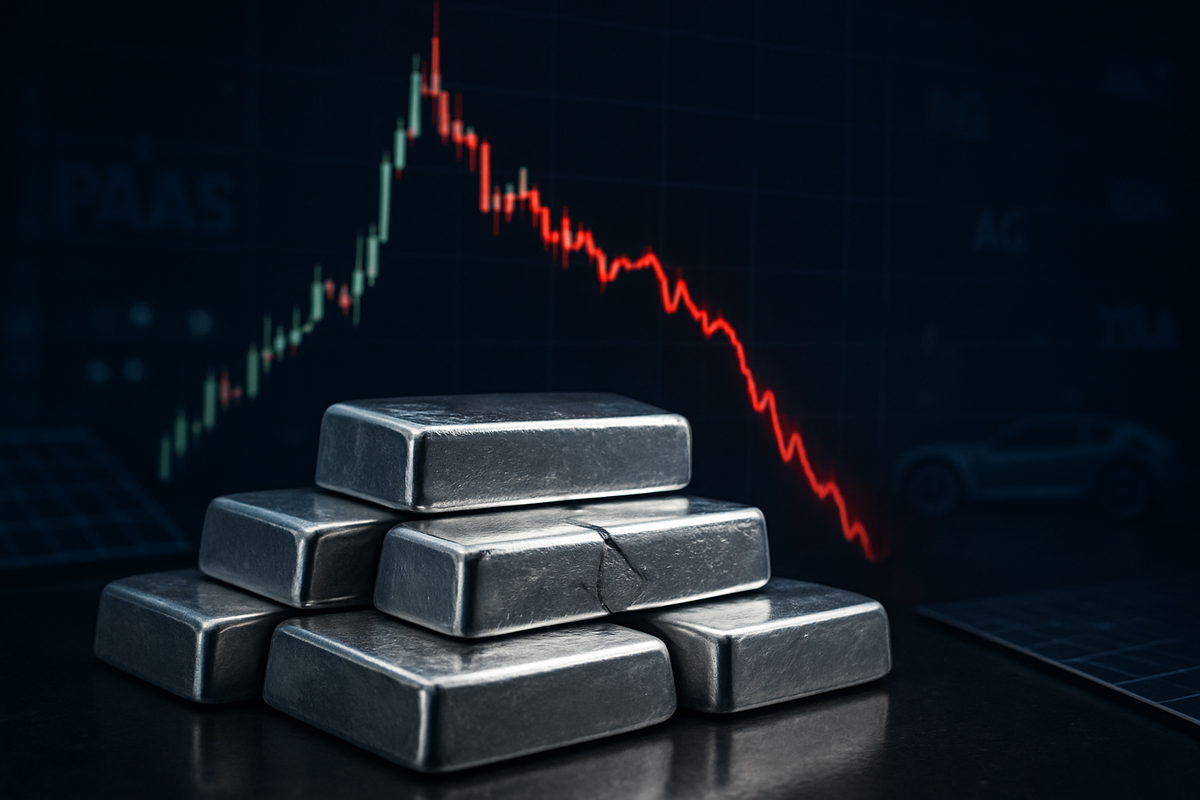
The global silver market experienced a historic day of reckoning on December 29, 2025, as prices for the precious metal suffered a violent retreat after touching an all-time intraday record of nearly $84 per ounce. The sharp 10% correction within a single trading session has sent shockwaves through the commodity pits, marking a volatile end to a year where silver nearly tripled in value. While the retreat provided a momentary sigh of relief for industrial consumers, it served as a stark reminder of the extreme leverage and speculative fervor that has come to define the "Silver Squeeze 2.0."
The immediate implications of this volatility are profound for both institutional hedgers and retail investors. As the CME Group (CME) moved aggressively to hike margin requirements to curb the "parabolic" ascent, leveraged traders were forced into a chaotic liquidation event. This price action suggests that while the structural bull case for silver remains intact due to its critical role in green energy, the market has entered a phase of heightened instability where double-digit daily swings may become the new normal.
The journey to silver’s record peak was a "perfect storm" of industrial scarcity and macroeconomic shifts. Starting the year at a modest $28.92 per ounce, silver prices spent the first half of 2025 grinding higher as the structural supply deficit entered its fifth consecutive year. The rally accelerated in October when the metal breached the long-standing psychological resistance of $50 per ounce. By late December, a combination of a weakening U.S. dollar and a scramble for physical metal ahead of new Chinese export restrictions pushed prices into a vertical climb. On December 28 and the morning of December 29, spot silver touched an unprecedented $83.62 per ounce, a level many analysts thought impossible just twelve months ago.
However, the peak was short-lived. The retreat began in the early afternoon of December 29, triggered by a confluence of events that caught the market off-guard. First, the CME Group (CME: NASDAQ) announced a significant increase in margin requirements for silver futures, effectively raising the cost of holding speculative positions. Simultaneously, reports of a breakthrough in geopolitical peace talks reduced the "safe-haven" premium that had been baked into precious metals. By the closing bell, silver had plummeted to the $72-$75 range, wiping out billions in paper wealth in a matter of hours.
Key stakeholders, including the London Bullion Market Association (LBMA) and major exchange-operated vaults, reported "extreme stress" as physical inventories in London and New York dropped by over 70% from their 2024 levels. The initial market reaction was one of stunned disbelief, with the Indian MCX exchange seeing prices crash by 8% in a single session. Traders who had been riding the "Silver Squeeze" momentum were forced to lock in profits or face margin calls, leading to a cascading sell-off that dominated financial headlines.
The extreme volatility of late 2025 has created a clear divide between those profiting from the "white metal" fever and those struggling to survive its costs. In the winner’s circle, pure-play silver miners have seen their valuations re-rated as "strategic national assets." Hecla Mining (HL: NYSE), the largest U.S. producer, saw its stock price surge nearly 300% year-to-date at the peak, as its fixed production costs allowed for massive margin expansion. Similarly, First Majestic Silver (AG: NYSE) benefited from its timely acquisition of the Cerro Los Gatos mine, which doubled its production capacity just as prices breached the $70 mark.
Streaming and royalty companies like Wheaton Precious Metals (WPM: NYSE) also emerged as winners, utilizing their fixed-cost models to maintain gross profit margins as high as 84%. By paying low, pre-agreed prices to miners while selling at the $80 peak, WPM demonstrated the resilience of the streaming model in a hyper-inflationary commodity environment. Pan American Silver (PAAS: NYSE) also capitalized on the rally, aggressively raising dividends to $0.14 per share as its Juanicipio mine reached full production.
Conversely, the "losers" of this event are the industrial giants for whom silver is a non-negotiable input. Tesla (TSLA: NASDAQ) faced a significant "cost-push" crisis, with CEO Elon Musk describing the silver price spike as "insane." Estimates suggest that at $80 per ounce, silver added hundreds of dollars to the manufacturing cost of every electric vehicle. First Solar (FSLR: NASDAQ), while more resilient due to its thin-film technology, still saw significant margin compression as the cost of silver paste tripled in the fourth quarter. These companies are now being forced to accelerate "thrifting" technologies—reducing the silver content in their products—to protect their bottom lines from future price spikes.
This event fits into a much broader trend of "resource nationalism" and the global race for critical minerals. The U.S. government’s decision earlier in 2025 to officially designate silver as a "critical mineral" signaled a shift in how the metal is perceived—no longer just a financial asset, but a vital component of national security and the energy transition. The volatility was further exacerbated by China’s announcement of new export licensing requirements, set to take effect on January 1, 2026. As China controls a significant portion of the refined silver supply, this move sparked a "vault drain" on Western exchanges as industrial users scrambled to secure physical metal before the window closed.
Historically, silver has been known for its "devilish" volatility, but the 2025 spike is being compared to the Hunt Brothers' attempt to corner the market in 1980. However, unlike the 1980 event, which was driven by speculative cornering, the 2025 rally is underpinned by a genuine industrial supply-demand imbalance. The ripple effects are being felt across the entire commodity complex, as traders look to other conductive metals like copper as potential substitutes, though silver’s unique properties make it difficult to replace in high-efficiency solar panels and AI data center hardware.
The regulatory implications are also mounting. Central banks and market regulators are now closely scrutinizing the role of Silver ETFs, such as the iShares Silver Trust (SLV: NYSE Arca), which saw record-breaking inflows of nearly 11 million ounces in a single week in October. There are growing calls for more transparent reporting of physical silver holdings to prevent the kind of speculative bubbles that lead to 10% single-day crashes.
In the short term, the market is likely to remain in a state of "exhausted consolidation" as traders digest the year-end retreat. The $70 level is expected to serve as a new floor, provided that the industrial demand from the solar and EV sectors remains robust. However, the long-term outlook is defined by a strategic pivot toward "thrifting." Companies like Tesla (TSLA: NASDAQ) are already intensifying research into copper-based metallization to bypass silver entirely, though these technologies are still years away from mass-market readiness.
Market opportunities may emerge for recycling firms and secondary silver processors. As the price of "new" silver remains high, the economics of recovering silver from old solar panels and electronic waste become highly attractive. We may see a new wave of investment into "urban mining" as a way to decouple from the volatile primary mining market and Chinese export restrictions. The primary challenge for 2026 will be navigating the new Chinese licensing regime, which could lead to a two-tiered pricing system for silver: one for the "Western" market and one for the "Eastern" market.
The 2025 silver spike and subsequent retreat mark a turning point in the history of the "white metal." The key takeaway for investors is that the era of "cheap silver" is likely over, but the path to higher prices will be fraught with violent corrections and regulatory interventions. The market has moved from being a sleepy corner of the precious metals world to a front-line battleground for the global energy transition and geopolitical supremacy.
Moving forward, the market will be defined by the tension between a structural supply deficit and the desperate "thrifting" efforts of industrial users. Investors should keep a close watch on COMEX and LBMA inventory levels, as well as any further updates on China’s export policies in early 2026. While the Dec 29 "bloodbath" was painful for many, it may have served a necessary purpose in flushing out excess speculation, setting the stage for a more sustainable, albeit still volatile, bull market in the years to come.
This content is intended for informational purposes only and is not financial advice.