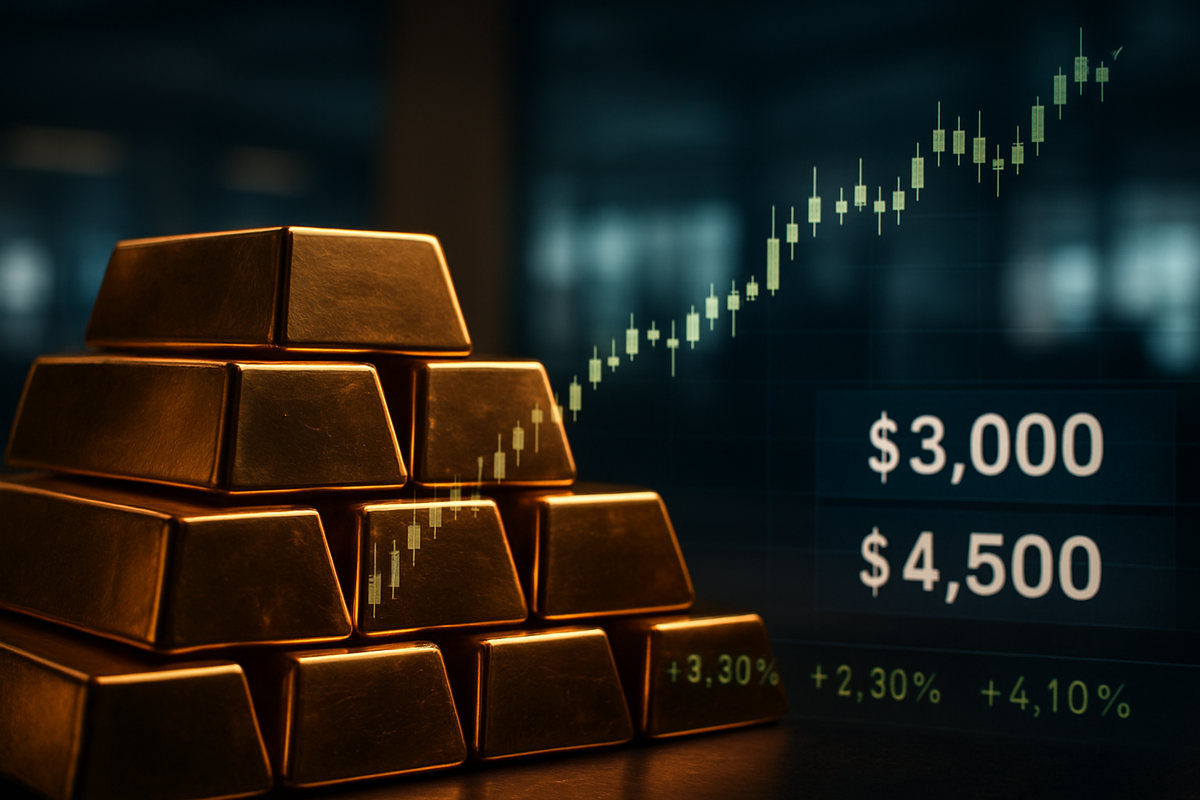
As 2025 draws to a close, the global financial landscape is grappling with a monumental shift in the commodities sector. Gold, the perennial safe-haven asset, has not only met the "red-hot" expectations set at the start of the year but has obliterated them. After spending years oscillating below the $2,100 mark, the precious metal underwent a vertical ascent in 2025, turning the once-ambitious $3,000 price target into a foundational support level for a market that is now eyeing even higher peaks.
This rally has fundamentally altered investor psychology, moving gold from a defensive hedge to a primary driver of portfolio alpha. As of late December 2025, spot gold prices have stabilized well above the $4,500 mark, marking a historic 70% year-to-date gain. The immediate implications are profound: central banks are re-weighting their reserves away from sovereign debt, and mining companies that once struggled with stagnant margins are now reporting record-breaking free cash flows, sparking a speculative frenzy in leveraged instruments.
The Road to $3,000 and Beyond: A Timeline of the Breakout
The journey to the $3,000 psychological threshold began in earnest during the final quarter of 2024, but the momentum reached an inflection point in early 2025. For months, analysts like Michael Widmer, Head of Metals Research at Bank of America, had been sounding the alarm on a "mismatch" between Western and Eastern demand. Widmer’s thesis—that a $3,000 price target was a "clean shot" once Western ETF investors joined the central bank buying spree—proved to be the definitive roadmap for the year. By the time the Federal Reserve signaled a definitive pause in its tightening cycle in the spring of 2025, the floodgates opened.
The breach of $3,000 occurred in mid-2025, triggered by a combination of worsening fiscal deficits in the United States and a sharp escalation in geopolitical tensions across Eastern Europe and South America. This was not a slow grind but a structural breakout. Market participants who had waited for a correction were left on the sidelines as gold recorded its strongest annual performance since 1979. Key stakeholders, including the World Gold Council and major institutional funds, noted that the traditional inverse relationship between gold and real interest rates had effectively decoupled, as investors prioritized "insurance" against currency debasement over nominal yields.
Initial market reactions were characterized by disbelief, followed by a rapid rotation into gold-linked equities. By the third quarter of 2025, the narrative had shifted from "Will gold reach $3,000?" to "How much higher can it go?" as the metal surged toward $4,000 and eventually $4,500. This acceleration was fueled by a "vote of no confidence" in the U.S. dollar, with central bank net purchases exceeding 1,000 tons for the fourth consecutive year, reaching a milestone where the market value of global gold reserves surpassed total holdings of U.S. Treasuries for the first time in history.
Winners, Losers, and the Speculative Surge
The primary beneficiaries of this "Golden Age" have been the major producers, who have seen their valuations skyrocket as the spot price of gold outpaced the rise in All-In Sustaining Costs (AISC). Newmont (NYSE: NEM), the world’s largest gold miner, transformed into a cash-generating powerhouse, with its stock price surging over 140% year-to-date to trade near $105 per share. Similarly, Barrick Gold (NYSE: GOLD) leveraged its disciplined balance sheet to deliver massive returns, with its stock doubling in value as it reported quarterly free cash flow exceeding $1.3 billion. Other major players like Agnico Eagle (NYSE: AEM) have also benefited, as their high-grade jurisdictions became increasingly attractive to investors seeking stability alongside growth.
However, the volatility inherent in such a rapid ascent has created a high-stakes environment for speculators. The Direxion Daily Gold Miners Index Bull 2X Shares (NYSEARCA: NUGT) became the vehicle of choice for those looking to amplify the rally. In 2025, NUGT delivered a staggering 465% return, moving from roughly $34 to over $200 as the underlying mining index outperformed the broader market. Conversely, the Direxion Daily Gold Miners Index Bear 2X Shares (NYSEARCA: DUST) served as a cautionary tale for contrarians. Those betting on a mean reversion or a "gold bubble" burst saw DUST collapse by nearly 90%, illustrating the extreme risks of using leveraged inverse products in a secular bull market.
The "losers" in this scenario have primarily been traditional fixed-income portfolios and the U.S. dollar index, which struggled to maintain its dominance as a reserve asset. Financial institutions that remained underweight in commodities throughout the first half of the year found themselves forced to chase the rally at significantly higher prices, leading to a "fear of missing out" (FOMO) phase that further propelled the metal's price toward the year-end highs.
A Structural Shift in Global Industry Trends
The 2025 gold rally is more than just a price spike; it represents a broader trend of "de-dollarization" and a return to hard assets. This event fits into a multi-year industry trend where emerging market central banks—led by China, India, and Turkey—have sought to insulate their economies from Western financial sanctions and inflationary pressures. The ripple effects have been felt across the mining industry, leading to a renewed wave of mergers and acquisitions as mid-tier miners seek to consolidate and increase their production capacity to capitalize on the $4,500+ environment.
From a policy perspective, the surge has sparked intense debate regarding the long-term sustainability of U.S. fiscal policy. With gold acting as a "barometer of distress," the breach of $3,000 and the subsequent run-up have put pressure on global regulators to address the growing disconnect between sovereign debt levels and real-world asset values. Historically, such moves in gold have preceded major shifts in the international monetary system, drawing comparisons to the collapse of the Bretton Woods system in the early 1970s.
Furthermore, the success of gold has revitalized interest in the entire commodities complex. Copper, silver, and platinum have all seen "sympathy rallies," as the infrastructure required for the global energy transition competes for capital with the safe-haven demand for bullion. This has led to a "commodity super-cycle" narrative that many analysts believe will persist well into the late 2020s, regardless of short-term fluctuations in interest rates.
What Lies Ahead: The Road to $5,000?
In the short term, the market is looking for signs of consolidation. After such an aggressive run, a period of "price discovery" around the $4,500 level is expected. However, the long-term outlook remains bullish for many analysts. If the Federal Reserve initiates the widely expected rate-cutting cycle in early 2026 to combat cooling economic growth, the "opportunity cost" of holding gold will drop even further, potentially providing the fuel needed for a run toward $5,000.
Strategic pivots are already underway within the mining sector. Companies are shifting their focus from aggressive cost-cutting to "growth at any cost," re-opening mines that were previously deemed uneconomical at $2,000 gold. This surge in supply, however, will take years to hit the market, suggesting that the supply-demand imbalance will remain in favor of the bulls for the foreseeable future. The primary challenge for the industry will be managing the inflationary pressures on labor and equipment that typically accompany such a massive commodity boom.
Potential scenarios for 2026 include a "stabilization phase" where gold trades between $4,200 and $4,800, or a "blow-off top" scenario if a major geopolitical crisis occurs. Investors are also watching for any regulatory changes regarding gold-backed ETFs or digital gold tokens, which could further democratize access to the metal and add another layer of liquidity to the market.
Final Thoughts: A New Era for the Yellow Metal
The year 2025 will be remembered as the year gold finally stepped out of the shadow of the U.S. dollar. The $3,000 target, once a bold prediction by Michael Widmer and his peers, now serves as a testament to the metal's enduring relevance in a volatile world. The primary takeaway for the market is that gold’s role has evolved; it is no longer just a "crisis asset" but a core component of a modern, diversified portfolio in an era of fiscal uncertainty.
Moving forward, the market will likely remain highly sensitive to U.S. Treasury yields and central bank rhetoric. However, the structural demand from the "Global South" and the institutional embrace of gold miners like Newmont and Barrick Gold suggest that the floor for prices has been permanently raised. The speculative energy seen in vehicles like NUGT and DUST highlights the intense interest in the sector, but also serves as a reminder of the volatility that accompanies such historic shifts.
Investors should keep a close eye on central bank reserve reports in the coming months. Any acceleration in gold accumulation by Western central banks—who have historically been sellers or neutral—could signal the next leg of this historic bull run. As we enter 2026, the question is no longer whether gold is a viable investment, but rather how much room remains in the "Golden Era."
This content is intended for informational purposes only and is not financial advice.