As of December 26, 2025, Tesla, Inc. (NASDAQ: TSLA) finds itself at a pivotal technical and fundamental junction. After a year defined by extreme volatility—including a mid-year "EV winter" that saw shares lose half their value—the stock has staged a remarkable recovery, currently trading in the $484 to $499 range. Investors are now laser-focused on whether the electric vehicle giant can maintain its momentum as it transitions from a high-volume automaker into a diversified artificial intelligence and robotics powerhouse.
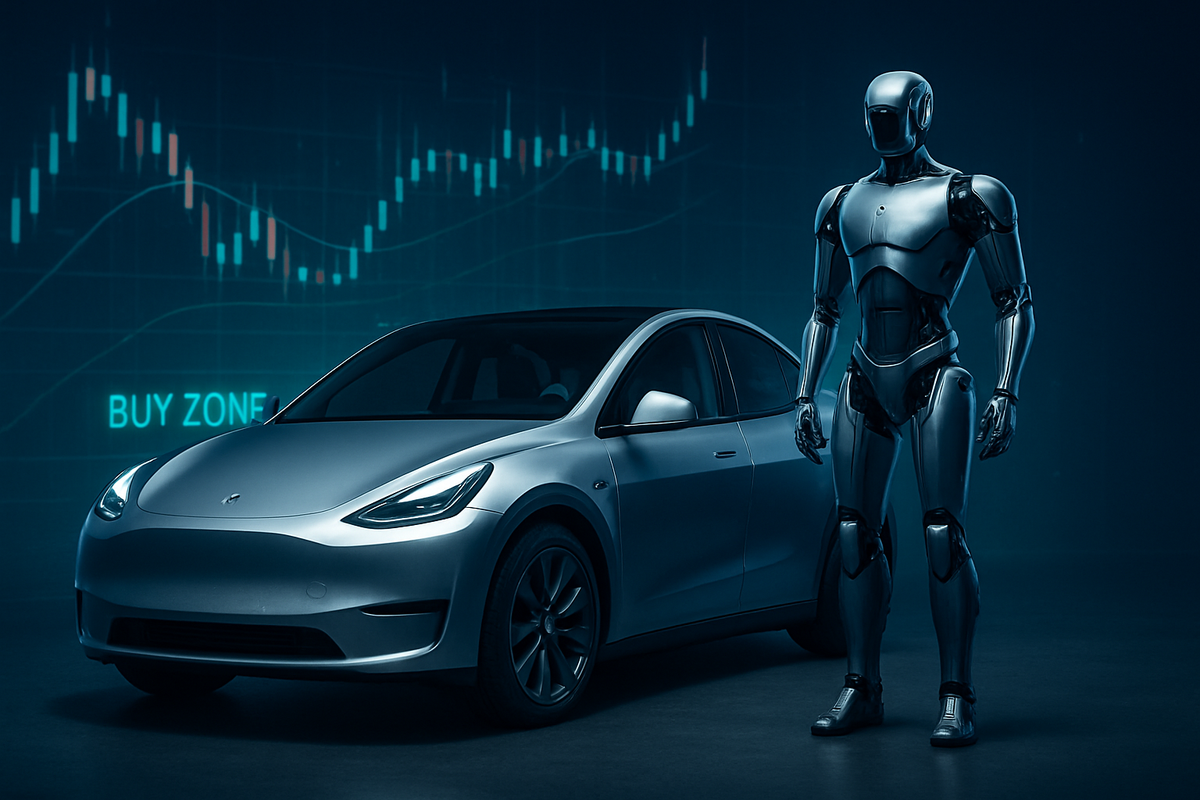
The immediate implications for the market are significant. With the stock approaching a psychological resistance barrier at $502, technical analysts are identifying specific "buy zones" where institutional accumulation is expected to provide a floor. This comes at a time when the broader EV sector is reeling from the expiration of federal tax credits and a shift in consumer demand toward hybrid models, leaving Tesla as one of the few pure-play EV makers still demonstrating resilience in the U.S. market.
Technical Support and the "October Hangover"
The final weeks of 2025 have been characterized by a high-stakes consolidation phase for Tesla. Following a record-breaking third quarter where the company delivered 497,000 vehicles, the market is now grappling with the "October hangover"—a sharp decline in demand following the September 30, 2025, expiration of the $7,500 federal EV tax credit. This "subsidy cliff" caused a nearly 40% industry-wide cratering in new orders, yet Tesla’s stock has remained surprisingly buoyant, forming what technical analysts describe as a "bull flag" pattern.
Primary "buy zones" have now been established between $465 and $480, levels where long-term investors have historically stepped in to defend the stock. A more conservative "line in the sand" exists at the $410 to $417 range, which aligns with the 200-day moving average and serves as a major long-term floor. On the upside, a breakout above $502 could trigger a short squeeze, with analysts at firms like Wedbush and Ark Invest setting a Q1 2026 price target of $530.55, representing the top of a multi-year rising channel.
The timeline leading to this moment has been fraught with challenges. Earlier in 2025, Tesla faced production delays for its "Model 2" affordable vehicle and hardware limitations for older vehicles running Full Self-Driving (FSD) v14. However, the successful launch of "unsupervised" FSD testing in Austin and the Bay Area in late 2025 has shifted the narrative. The market is no longer just pricing Tesla based on its automotive gross margins—which have stabilized at 17% to 18%—but rather on its potential to dominate the nascent Robotaxi and humanoid robot sectors.
The Competitive Landscape: Winners and Losers in the 2025 EV Shift
The current market environment has created a stark divide between winners and losers. Tesla remains the dominant domestic player, protected by new 100% tariffs on Chinese-made EVs that have effectively locked out low-cost competitors from the U.S. market. However, globally, the story is different. BYD Company Limited (OTC:BYDDY) has emerged as the "undisputed king" of 2025, outselling Tesla in pure battery-electric vehicles (BEVs) for four consecutive quarters. Through Q3 2025, BYD delivered 1.61 million BEVs compared to Tesla's 1.22 million, highlighting the intense pressure Tesla faces in international markets like Europe and Southeast Asia.
In the U.S., Rivian Automotive (NASDAQ: RIVN) has surprised skeptics, emerging as a primary "survivor" of the EV winter. With its stock up 67% year-to-date, Rivian is gearing up for the launch of its R2 SUV in early 2026, which is positioned as a direct threat to Tesla's aging Model Y. Conversely, traditional automakers like Ford Motor Company (NYSE: F) have largely retreated from the EV "arms race." In December 2025, Ford announced a staggering $19.5 billion writedown, canceling several next-gen EV programs to pivot back to extended-range electric vehicles (EREVs) and traditional hybrids.
Tesla’s ability to maintain its premium valuation—currently sporting a P/E ratio of approximately 300—depends heavily on its perceived lead in AI. While legacy OEMs struggle with software integration and battery costs, Tesla’s vertical integration has allowed it to weather the storm. However, the bear case remains vocal, arguing that Tesla is still a capital-intensive car company being priced like a software firm, despite a 14% year-over-year decline in some of its older delivery segments.
Broader Industry Trends and Regulatory Whiplash
The events of 2025 represent a fundamental shift in the global automotive industry. The "regulatory whiplash" of the past year, including a 35-day federal government shutdown and the expiration of key subsidies, has forced a consolidation of the market. Tesla’s pivot to AI and robotics fits into a broader trend where "software-defined vehicles" are becoming the primary value driver. The introduction of the Optimus Gen 3 humanoid robot prototype in late 2025 further signaled Tesla's intent to diversify its revenue streams away from purely cyclical auto sales.
Historically, this period mirrors the early days of the smartphone industry, where hardware became commoditized and the real value shifted to the ecosystem and autonomous capabilities. Tesla’s FSD v14 is now being viewed as the "iOS of autonomy," with rumors circulating that other struggling automakers may seek to license the technology in 2026 to avoid further R&D writedowns. However, regulatory hurdles remain high; the "unsupervised" testing in Texas is a localized win, but a nationwide rollout of Robotaxis faces a patchwork of state-level restrictions and federal safety probes.
The 100% tariffs on Chinese EVs have also created a "protected bubble" for U.S. manufacturers, but this comes at a cost. Supply chain complications arising from geopolitical tensions have kept battery costs higher than expected, preventing the rapid price parity with internal combustion engines that many predicted for 2025. Tesla’s "unboxed" manufacturing process, intended for the upcoming Cybercab, is seen as the industry’s best hope for breaking this cost barrier.
The Road Ahead: Cybercabs and "Model 2" Scaling
Looking toward 2026, Tesla’s strategic focus will be on volume scaling and the monetization of its AI stack. The Cybercab is officially scheduled for production in Q2 2026 at Giga Texas, and its success will be the ultimate litmus test for the company’s "unboxed" manufacturing strategy. If Tesla can produce a dedicated autonomous vehicle for under $25,000, it could fundamentally disrupt the ride-hailing market currently dominated by human-driven platforms.
Short-term, the challenge will be navigating the "subsidy-free" environment in the U.S. Tesla may need to engage in further price cuts to stimulate demand, which could temporarily compress margins below the 17% floor. However, the potential for high-margin software revenue from FSD subscriptions and the eventual launch of the "Model 2" affordable vehicle—now expected to scale in volume by late 2026—provides a compelling long-term narrative for those buying in the current support zones.
Investors should also watch for the potential spin-off or deeper integration of the Optimus robotics division. As labor costs continue to rise globally, the humanoid robot play is moving from a "science project" to a tangible industrial solution. Any news regarding the first commercial deployments of Optimus in Tesla’s own factories during the first half of 2026 could serve as a massive catalyst for the stock.
Summary for Investors
Tesla enters the close of 2025 as a company in transition. The record Q3 deliveries proved that demand for the brand remains robust, but the "subsidy cliff" and rising competition from BYD and Rivian have forced a reality check on its automotive growth rates. The stock’s presence in the $465 - $480 "buy zone" offers a tactical entry point for those who believe in the AI and robotics thesis, though the sky-high P/E ratio demands a high degree of risk tolerance.
Moving forward, the market will be watching two key metrics: the pace of FSD adoption and the timeline for the Cybercab rollout. If Tesla can successfully bridge the gap between being a car company and an AI firm, the current consolidation phase may be remembered as the "launchpad" for its next leg higher. However, any delays in the 2026 product roadmap or further regulatory setbacks in autonomous driving could see the stock test its deeper support levels at $410.
For the coming months, the focus will remain on the Q4 2025 earnings call in January, where CEO Elon Musk is expected to provide updated guidance on the "Model 2" and the first revenue projections for the Robotaxi network. Investors should remain vigilant, as the transition from hardware to software-driven value is rarely a linear path.
This content is intended for informational purposes only and is not financial advice.