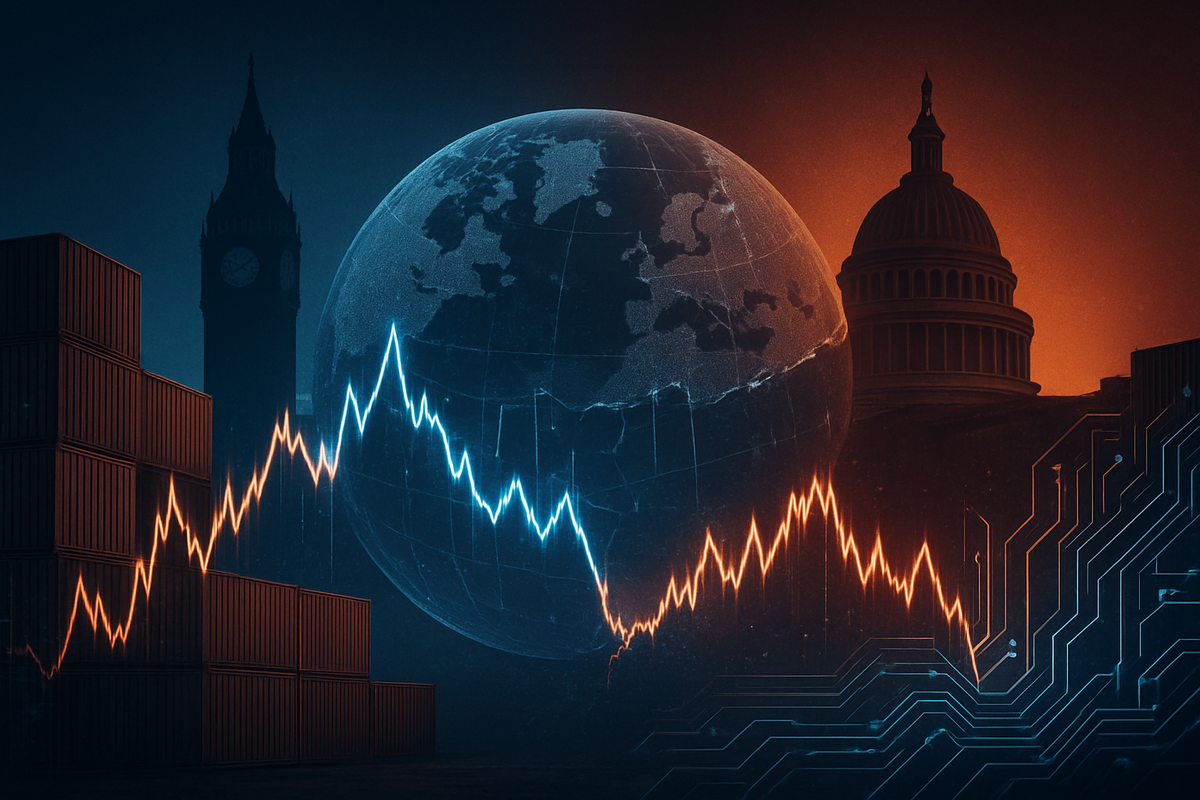
As of December 24, 2025, the global financial landscape is grappling with a Christmas season defined by high-stakes brinkmanship and "America First" economic policies. The second year of the Trump administration has seen a fundamental rewriting of international trade norms, characterized by a "year of the tariff" and a volatile "Special Relationship" with the United Kingdom. While the S&P 500 has proven resilient, climbing 15% year-to-date despite a catastrophic $5 trillion wipeout in April, the atmosphere remains one of "wait and see" as investors navigate the fallout of suspended trade deals and looming legal challenges.
The immediate implications are most visible in the UK, where the sudden suspension of the $41 billion Technology Prosperity Deal (TPD) on December 15 has sent shockwaves through the City of London. Washington’s decision to freeze the deal—citing the UK’s persistent 2% Digital Services Tax and resistance to U.S. agricultural standards—has left British tech and energy sectors in a state of uncertainty. For global markets, the "Trump Trade" 2.0 has replaced traditional valuation metrics with the "TACO trade"—a volatile mix of Tariffs, AI, Central bank pivots, and OPEC production—leaving multi-national corporations scrambling to adapt to a fragmented global order.
A Year of "Liberation" and Friction: The 2025 Timeline
The defining moment of the current market cycle occurred on April 2, 2025, dubbed "Liberation Day" by the administration. Invoking the International Emergency Economic Powers Act (IEEPA), President Trump imposed a blanket 10% baseline tariff on all imports, with reciprocal rates spiking to 49% for certain non-compliant nations. This move triggered the deepest two-day loss for the S&P 500 in history, as markets struggled to price in a move away from decades of globalization. However, by late 2025, the effective average tariff rate has stabilized at 16.8%, following a series of bilateral "truces" and the emergence of the "Pax Silica"—a U.S.-led technology alliance designed to exclude Chinese influence.
The relationship with the United Kingdom followed a similarly erratic trajectory. In September 2025, a historic State Visit to London culminated in the signing of the TPD, intended to align the two nations on quantum computing and nuclear energy. This optimism was short-lived. By mid-December, the Trump administration leveraged the deal as a bargaining chip, demanding that Prime Minister Keir Starmer’s government scrap taxes targeting U.S. tech giants. This "hardball diplomacy" has created a rift that markets are still digesting, as billions in promised U.S. investment now sit in limbo while the UK refuses to compromise on its food safety standards.
Key stakeholders in this drama include the U.S. Department of Commerce, which has collected roughly $250 billion in tariff revenue to date, and the UK’s Treasury, now facing a potential investment vacuum. In the final days of 2025, the administration has pivoted toward domestic populism, proposing to use tariff revenues for a $1,776 "warrior dividend" for active-duty service members and $2,000 rebate checks for citizens—a move that has buoyed U.S. consumer-facing stocks even as global sentiment remains fragile.
The Winners and Losers of the New Economic Order
The "America First" resurgence has created a stark divide among U.S.-listed multinationals. Among the primary beneficiaries are domestic energy producers and defense contractors. ExxonMobil (NYSE: XOM) and other shale giants have thrived under a policy of "drill, baby, drill," supported by Trump’s pressure on OPEC to maintain high production levels, which has kept Brent crude in the $60–$65 range. Similarly, Lockheed Martin (NYSE: LMT) and other defense firms are seeing increased demand as the U.S. pushes for a "Pax Silica" defense umbrella and increases military spending funded by tariff revenues.
Conversely, technology giants and traditional exporters are navigating a minefield. Apple (NASDAQ: AAPL) remains particularly vulnerable due to its complex supply chains in Asia, though it has benefited from the recent October "truce" with China. However, the suspension of the UK tech deal has directly impacted firms like Alphabet (NASDAQ: GOOGL) and Amazon (NASDAQ: AMZN), which are the primary targets of the UK’s Digital Services Tax. These companies now find themselves caught in a cross-continental regulatory tug-of-war, with their European expansion plans stalled by the diplomatic freeze.
In the financial sector, the impact is mixed. While U.S. investment banks have seen a surge in "volatility trading" revenue, those with heavy international footprints like HSBC (NYSE: HSBC) are feeling the pinch of a fractured global trade system. The "TACO trade" has rewarded firms that can pivot quickly, but the increased cost of capital in a tariff-heavy environment is beginning to weigh on long-term capital expenditure for multinationals that rely on seamless cross-border logistics.
The Death of Globalization and the Rise of "Pax Silica"
The events of 2025 represent a decisive shift from the post-Cold War era of globalization toward a more transactional, protectionist world order. The "Pax Silica" alliance is perhaps the most significant structural change, attempting to create a "digital iron curtain" that separates Western tech ecosystems from those of China. This fits into a broader industry trend of "friend-shoring," where companies are encouraged—or forced—to relocate supply chains to allied nations, though the recent friction with the UK suggests that even "friends" are not immune to tariff-based leverage.
Regulatory implications are also reaching a boiling point. The U.S. Supreme Court is currently "fast-tracking" a ruling on the legality of the April tariff regime, with a decision expected in early 2026. This legal uncertainty has driven investors toward safe havens, pushing gold to a historic high of $4,497.55 per ounce on December 23. Historical comparisons are being drawn to the Smoot-Hawley era, though proponents of the current administration argue that the AI-driven productivity boom provides a "cushion" that didn't exist in the 1930s.
The ripple effects on competitors are profound. European firms that cannot pivot to the U.S. market are seeing their valuations languish compared to their American counterparts. This "U.S. Exceptionalism" in the stock market is creating a feedback loop where capital continues to flow into the S&P 500, further draining liquidity from the London Stock Exchange and other European hubs.
What Lies Ahead: The 2026 Outlook
Looking toward 2026, the market faces several potential "cliffs." The most immediate is the Supreme Court’s ruling on executive tariff authority. A ruling against the administration could spark a massive market correction as the revenue for proposed tax cuts and dividends vanishes. Conversely, a victory for the administration would likely embolden further protectionist measures, potentially expanding tariffs to include services and digital trade more broadly.
Strategic pivots will be required for multinationals to survive. We expect to see an increase in "corporate re-domiciling," where firms move their legal headquarters to the U.S. to avoid being on the wrong side of the tariff wall. Additionally, the suspension of the UK-US tech deal may force a strategic realignment in London, perhaps pushing the UK back toward closer regulatory alignment with the European Union—a move that would create its own set of market disruptions.
Short-term opportunities may emerge in the "reconstruction" of domestic manufacturing. Companies that provide automation and robotics to U.S. factories are poised for growth as the "warrior dividend" and other populist measures stimulate domestic demand. However, the long-term challenge remains inflation; while the administration claims tariffs are paid by foreign nations, the 4.3% GDP growth in Q3 is being shadowed by a five-month decline in consumer sentiment as the "pass-through" costs of imports begin to hit American wallets.
Summary: Navigating the New Volatility
As 2025 draws to a close, the key takeaway for investors is that volatility is no longer an anomaly—it is a policy tool. The Trump administration’s use of tariffs as a primary negotiating lever has successfully re-centered the global economy around the U.S., but at the cost of traditional diplomatic stability and predictable market growth. The "Special Relationship" with the UK is currently the primary casualty of this approach, serving as a cautionary tale for other nations attempting to maintain independent regulatory regimes.
Moving forward, the market will likely continue its bifurcated path. U.S.-centric sectors like energy and domestic tech will likely lead, while global multinationals will face a persistent "complexity discount." Investors should keep a close watch on the Supreme Court’s upcoming docket and any signs of a "thaw" in the UK-US tech negotiations. In this new era, the "TACO trade" is the only game in town, and those who cannot digest the volatility may find themselves left behind in the 2026 rally.
This content is intended for informational purposes only and is not financial advice.