AUSTIN - December 16, 2025 - Enterprise organizations are confronting an uncomfortable reality about their training video investments: employees complete courses for compliance requirements, then never return to the content. When institutional knowledge is needed months later, hundreds of hours of internal video prove nearly impossible to navigate, leaving expertise trapped in formats that don't support retrieval.
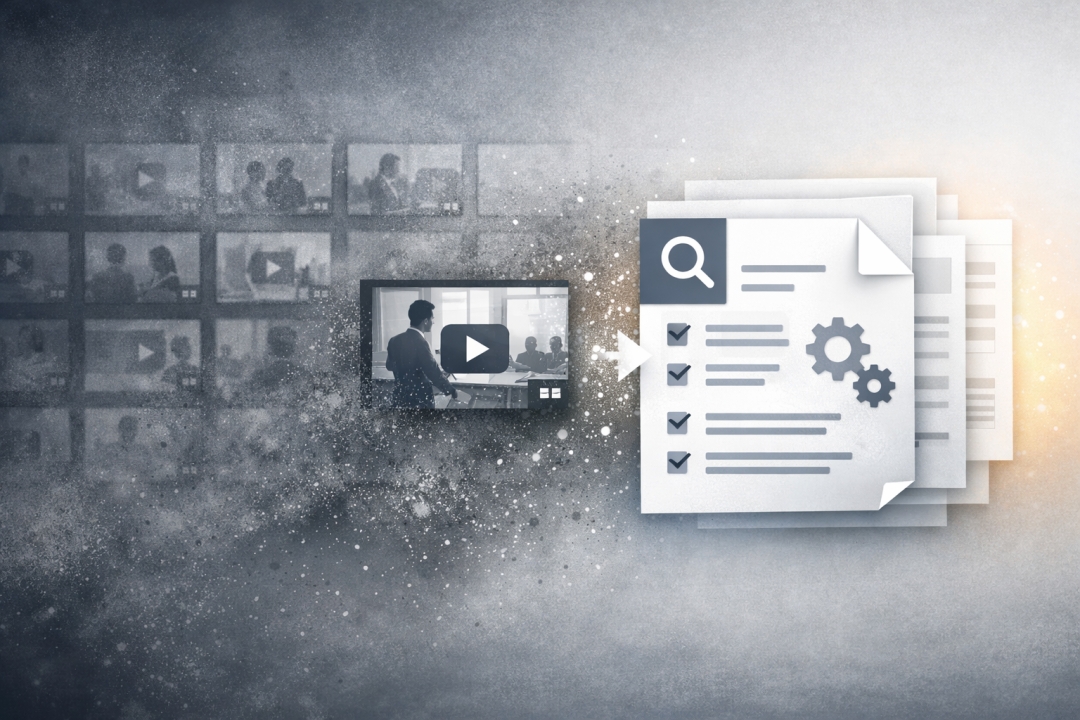
Docsie, an AI-powered documentation platform, reports a significant increase in enterprises converting existing training video libraries into searchable, structured documentation — not to replace video content, but to finally extract value from years of production investment.
"The video exists. The knowledge is captured. But no one has 45 minutes to rewatch an onboarding module to find one procedural answer," said Philippe Trounev, CEO of Docsie. "Companies are sitting on libraries of 300, 500, even thousands of hours of internal training content. Employees completed the courses. The completion rates look fine. But completion isn't the same as accessible knowledge."
The Post-Completion Problem
Organizations have invested heavily in video-based training, particularly during the shift to remote and hybrid work. Internal process videos, SOP walkthroughs, software training, and compliance modules now represent significant institutional assets — in some cases, libraries exceeding 3,000 videos.
The challenge emerges after completion. When an employee needs to reference a specific process six months after initial training, the options are limited: scrub through hours of footage searching for the relevant segment, ask a colleague who may or may not still be with the company, or recreate the solution from scratch.
"Training video is optimized for initial learning, not retrieval," Trounev noted. "You can't search inside a video. You can't skim it. When expertise walks out the door, those videos don't fill the gap — they just sit there."
From Passive Content to Active Knowledge
The shift toward AI-generated documentation addresses this gap by converting video content into searchable, structured formats. Rather than abandoning video investments, enterprises are treating conversion as a recovery strategy — transforming passive viewing content into reference material employees can actually use.
Docsie's platform processes internal training videos, Zoom recordings, and legacy content libraries, generating documentation that preserves institutional knowledge in accessible formats. The approach allows organizations to maintain compliance-oriented video training while creating parallel documentation for day-to-day knowledge retrieval.
Institutional Knowledge at Risk
The urgency is compounded by workforce dynamics. As employees transition between roles or leave organizations entirely, tacit knowledge leaves with them. Training videos created by departed subject matter experts remain in libraries but become increasingly difficult to leverage without context.
"Every company has this problem," Trounev said. "The person who recorded the training three years ago is gone. The process has evolved. The video is technically still accurate but no one knows which parts. Converting to documentation creates a living asset you can update, search, and actually use."
About Docsie
Docsie is an AI-powered knowledge orchestration platform that helps enterprises convert, manage, and deliver documentation at scale. The platform transforms video content, legacy documents, and institutional knowledge into searchable, structured documentation accessible across teams and systems.
For more information, visit https://www.docsie.io/solutions/internal-process-videos-to-sops/.
Media Contact
Company Name: Docsie Inc.
Contact Person: Philippe Trounev
Email: Send Email
Phone: 4169028771
Address:1207, 701 Tillery Street Unit 12
City: Austin
State: TX
Country: United States
Website: https://www.docsie.io